QuickBooks vs ERP: When Accounting Software Isn’t Enough (2026)

If you’ve outgrown QuickBooks, you know the feeling. The spreadsheets are multiplying, inventory counts are wrong more often than they’re right, month-end close takes twice as long as it should, and your team is spending more time working around the system than working inside it.
QuickBooks was built for accounting. It handles invoicing, bill payment, and basic financial reporting well. But it was never designed to run a distribution or manufacturing operation with multiple warehouses, thousands of SKUs, complex purchase orders, and a growing team that needs real-time data across departments.
This guide identifies the 12 clearest signs a business has outgrown QuickBooks, explains what it actually means to outgrow your accounting software, and walks you through the features to look for when choosing an ERP replacement.
If you’re asking, “How do I know if I have outgrown QuickBooks?”, the answer is usually that you already know. The question is what to do about it.
What Does It Mean to “Outgrow” QuickBooks?
Outgrowing QuickBooks doesn’t mean the software stopped working. It means the gap between what your business needs and what QuickBooks can deliver has become wide enough that the workarounds cost more than a proper solution would.
QuickBooks is accounting software. It tracks money in and money out.
When your business starts requiring real-time inventory visibility, multi-warehouse management, manufacturing planning, integrated CRM, or cross-departmental automation, QuickBooks can’t accommodate those needs without bolt-on tools, manual processes, and spreadsheets that introduce errors and slow your team down.
The inflection point varies by company, but it typically occurs when operational complexity outpaces a financial system’s capacity to manage it.
For distributors, it’s usually inventory accuracy. For manufacturers, it’s production planning. For multi-location businesses, it’s consolidated reporting.
The common thread is that QuickBooks becomes the bottleneck instead of the backbone.
12 Top Signs You’ve Outgrown QuickBooks
The signs you have outgrown QuickBooks tend to compound over time. What starts as a minor inconvenience becomes a structural limitation that affects every department. Here are the 12 most common signals we see across distributors and manufacturers in the SMB space.
Sign 1: You’re Managing Critical Processes in Spreadsheets
When core business processes like inventory tracking, order management, and procurement start living in Excel rather than your accounting system, QuickBooks has reached its operational ceiling. The reliance on manual data re-entry between disconnected tools is both a symptom and the source of compounding errors. If your team maintains more spreadsheets than QuickBooks workflows, the system is no longer serving you.
Sign 2: Inventory Tracking Is Getting Too Complex
QuickBooks tracks what you bought and sold, but it can’t manage multiple warehouses, lot tracking, serial numbers, expiration dates, or real-time stock levels across locations. Once you pass a few hundred SKUs or add a second warehouse, inventory accuracy in QuickBooks depends entirely on manual updates that your team will inevitably fall behind on.
Sign 3: You Need Consolidated Reporting Across Multiple Entities
QuickBooks Online requires separate subscriptions per entity, and Enterprise lacks true multi-entity consolidation. If you’re running multiple locations, legal entities, or sales channels, producing a consolidated financial picture means exporting data into spreadsheets and manually reconciling. This creates lag, errors, and a version-control problem that worsens every month.
Sign 4: Financial Reporting Takes Too Long Every Month
When month-end close requires pulling data from multiple systems, reconciling spreadsheets, and manually entering transactions, the process becomes a recurring drain on finance team capacity. Controllers spending three to five days closing the books every month are not doing strategic work. They’re compensating for system limitations. A full ERP centralizes that data and automates the reconciliation work that QuickBooks forces your team to do by hand.
Sign 5: Your Team Is Entering the Same Data in Multiple Systems
Duplicate data entry is the clearest sign of system fragmentation. When your accounting team enters an invoice in QuickBooks, your operations team logs the same order in a spreadsheet, and your warehouse tracks it in a third tool, you’re paying for three inputs when one should suffice. Every duplicate entry is an opportunity for error.
Sign 6: You Need More Advanced Financial Controls and Permissions
QuickBooks offers basic role-based access, but growing businesses need granular permission controls: approval workflows for purchase orders, segregation of duties for financial transactions, audit trails for compliance, and role-specific dashboards. Without these, you’re either over-exposing sensitive data or creating manual approval bottlenecks.
Sign 7: QuickBooks Struggles With Your Transaction Volume
QuickBooks Online slows noticeably with high transaction volumes, large customer/vendor lists, and complex reporting queries. Enterprise performs better but has a hard ceiling. If your team waits for reports to load, experiences sync delays, or hits performance walls during peak periods, you have outgrown the platform’s technical capacity.
Sign 8: You Lack Real-Time Visibility Into Business Performance
QuickBooks reporting is financial and backward-looking. It tells you what happened last month. Growing businesses need to know what’s happening now: current inventory levels, open orders, fulfillment status, production progress, and margin by customer. If answering basic operational questions requires pulling data from multiple sources and assembling it in Excel, you are making decisions on stale information.
Sign 9: You’re Managing Manufacturing or Supply Chains Outside Your Accounting System
QuickBooks has no native support for bills of materials, work orders, MRP, or vendor management workflows. For manufacturers and distributors, this means production planning, material requirements, and supplier management live entirely outside your financial system. As production complexity grows, operating critical processes without a system of record becomes a compounding risk.
Sign 10: Too Many Integrations Are Holding Your Tech Stack Together
If you’re running QuickBooks plus an inventory app, plus a shipping tool, plus a CRM, plus a reporting tool, and they’re connected through Zapier, middleware, or manual exports, your tech stack is a fragile patchwork. Each integration point is a potential failure. When one breaks, data stops flowing, and your team scrambles. A single ERP replaces the patchwork with a unified platform.
Sign 11: Manual Work Is Slowing Down Your Finance Team
Manual bank reconciliation, manual invoice matching, manual journal entries, and manual intercompany transfers. When every step in your financial workflow requires human intervention, your finance team becomes a bottleneck that grows proportionally with transaction volume. An ERP automates the routine work, so your team can focus on analysis and decision-making.
Sign 12: Scaling the Business Means Hiring More Admin Staff
If every increase in order volume requires hiring another person to manage manual processes, you’re scaling headcount linearly with revenue. That’s not sustainable. Automation through an ERP, including automated reorder points, barcode scanning, integrated order-to-cash workflows, and real-time reporting, lets you grow without proportionally growing your back-office team.
Why You Should Switch to ERP If You’ve Outgrown QuickBooks
The switch from QuickBooks to ERP isn’t about getting a bigger version of the same thing. It’s about moving from a system that tracks financial transactions to a platform that runs the entire operation. Here are the main reasons why you should switch to ERP:
One System Instead of Five
An ERP replaces QuickBooks, your inventory spreadsheet, your shipping tool, your CRM, and your production tracker with a single platform where every transaction updates in real time across every department. No more reconciliation between systems. No more duplicate entries. No more wondering which version of the data is correct.
Real-Time Visibility Across the Entire Business
Controllers can see margin by customer. Operations managers can see fulfillment rates. Warehouse staff can see real-time stock levels. Sales can see what is available to promise. Everyone works from the same data, updated in real time, without waiting for someone to export a spreadsheet.
Automation That Replaces Manual Processes
Automated reorder points trigger purchase orders when stock drops below threshold. Barcode scanning eliminates manual inventory counts. Order-to-cash workflows move from quote to invoice without manual handoffs. The processes that consume your team’s time in QuickBooks happen automatically in an ERP.
Financial Controls That Match Your Growth
Granular role-based permissions, approval workflows, segregation of duties, and complete audit trails give your finance team the controls they need without manual bottlenecks. Multi-entity consolidation happens in the system, not in a spreadsheet.
Scalability Without Proportional Headcount Growth
An ERP lets you double order volume without doubling admin staff. The system handles the increased complexity through automation and integration, not through more people doing more manual work.
Key Features to Look for When Choosing the Right ERP for Your Business
Here are the main features to look for when deciding which ERP is right for your business:
Multi-Warehouse Inventory Management
Real-time stock visibility across every location, with bin-level tracking, lot and serial number management, barcode scanning, and automated cycle counting. This is the single most common gap that drives businesses away from QuickBooks.
Integrated Financial Management (GAAP-Compliant)
Full accounting that handles multi-entity consolidation, multi-state tax compliance, revenue recognition, bank reconciliation, and financial reporting. Your ERP should replace QuickBooks entirely for accounting, not run alongside it.
Manufacturing and MRP
If you manufacture, you need bills of materials, work orders, production scheduling, and material requirements planning integrated with inventory and purchasing. This functionality doesn’t exist in QuickBooks at any tier.
Order Management (Quote-to-Cash)
End-to-end order processing from quote to sales order to pick/pack/ship to invoice to payment, with real-time status updates and margin visibility at every step.
Procurement and Purchase Order Management
Automated purchase orders based on reorder points, vendor management, receiving workflows, and three-way matching (PO, receipt, invoice) that connects purchasing to inventory and accounting.
CRM Connected to Operations
Customer data linked to sales history, open orders, inventory availability, and financials. Your sales team sees the full picture without switching systems.
Reporting and Real-Time Dashboards
Out-of-the-box reports for margin by customer, inventory valuation, aging, fulfillment rates, and production status. Controllers and operations managers shouldn’t need to export to Excel to answer basic business questions.
Native Integrations
Vendor-built integrations with e-commerce platforms (Shopify, Amazon), shipping carriers (ShipStation, FedEx, UPS), EDI trading partners, and payment processors. Native means the ERP vendor maintains the integration, not a third-party app developer.
Check Out Kechie, the ERP System Made for Businesses Outgrowing QuickBooks
We built Kechie specifically for the transition from QuickBooks to ERP. It’s a fully integrated, cloud-based ERP for fast-growing small to mid-size distributors and manufacturers (doing 7 digits in revenue or over $1M in revenue) that replaces the entire patchwork of QuickBooks, bolt-on apps plus spreadsheets with a single platform.
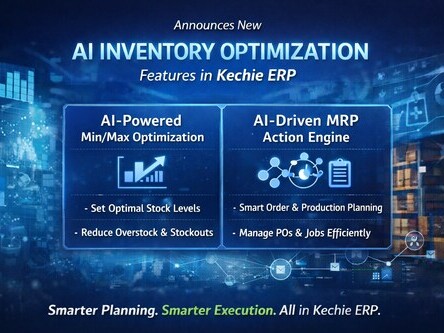
Inventory management, warehouse management, MRP, order processing, procurement, CRM, logistics, and GAAP-compliant financials all run on one database with real-time visibility across every module.
Implementation takes weeks, not months. Our team helps with data migration from QuickBooks, configures workflows to match your processes, and trains your staff. The intuitive user interface makes training a breeze. No dedicated IT team or ERP administrator is required.
Kechie is a ready-to-go, subscription-based software solution, with pricing based on the packages you select. Companies can start with our Inventory Package, which manages all the ways inventory comes into and goes out of your company. This includes CRM, procurement, logistics, inventory management, warehouse management (WMS), and order management.
There are no hidden fees, and we support the implementation by providing a dedicated project manager and engineer to help ensure a smooth and successful rollout.
Kechie is also highly scalable based on your business requirements. As your operations grow, you can easily add modules such as Accounting, full Manufacturing, Equipment Maintenance, customer and vendor portals, and much more.
“When looking at new ERP software, we reviewed six or seven different software packages. Kechie was the one who gave us everything we were looking for. And, our decision turned out to be a great one. I would highly recommend Kechie to anyone looking for a new ERP system!”
➤ See Kechie in action: Schedule your free ERP demo
FAQs
How big is too big for QuickBooks?
There is no single revenue or employee threshold where a business outgrows QuickBooks. The real signal is operational complexity, not company size. Businesses with multiple warehouses, manufacturing processes, or teams approaching the 25-user limit often start running into its limitations. When critical processes are being managed in spreadsheets or separate systems because QuickBooks cannot support them, it’s usually a sign the business has outgrown it.
What’s the difference between QuickBooks and an ERP system?
QuickBooks is accounting software that manages financial transactions. An ERP manages the entire business: accounting plus inventory, warehouse management, manufacturing, CRM, procurement, and order processing in one integrated system. QuickBooks tracks money. An ERP tracks money and everything that generates it.
How do I know if I’ve outgrown QuickBooks?
The clearest indicators are: managing critical processes in spreadsheets, declining inventory accuracy, month-end close taking more than a few days, duplicate data entry across multiple systems, and workarounds that outnumber actual workflows. If your team spends more time compensating for QuickBooks’ limitations than using it productively, you have outgrown it.
Do big companies use QuickBooks?
Some larger companies use QuickBooks for basic accounting, but virtually none rely on it as their operational system. Companies with complex inventory, manufacturing, or multi-location operations use ERP systems. QuickBooks is designed for small businesses with straightforward accounting needs, not for operational management at scale.
Is switching from QuickBooks to an ERP disruptive?
It doesn’t have to be. With a cloud ERP like Kechie, implementation takes weeks. Data migration from QuickBooks is a defined process: customers, vendors, products, open orders, and financial history transfer into the new system. The disruption of switching is typically far less than the ongoing disruption of working around QuickBooks’ limitations every day.
At what revenue or company size should a business consider moving to an ERP?
Revenue is less relevant than operational complexity. That said, businesses between $2M and $250M in revenue with 15 or more employees and inventory-dependent operations are the typical ERP transition point. The trigger is usually a specific pain point: inventory inaccuracy, manufacturing needs, multi-location operations, or a month-end close that takes too long.
Is QuickBooks going to be discontinued?
QuickBooks Online is not being discontinued. However, Intuit is phasing out QuickBooks Desktop, pushing users toward QuickBooks Online, which is cloud-based but even more limited for inventory, manufacturing, and multi-entity operations. For businesses already outgrowing QuickBooks Desktop, moving to QuickBooks Online is a lateral step, not a solution.
What do big companies use instead of QuickBooks?
Mid-size and growing companies typically move to ERP systems such as Oracle NetSuite, Microsoft Dynamics 365, Acumatica, SAP, or modern cloud ERP solutions like Kechie. The right choice depends on industry, operational complexity, and growth plans. For distributors and manufacturers moving beyond QuickBooks, Kechie provides a streamlined upgrade path designed for growing teams.
Can an ERP replace QuickBooks entirely, or do both need to run in parallel?
A full ERP replaces QuickBooks entirely. It includes accounting functionality (general ledger, accounts payable/receivable, bank reconciliation, financial reporting) plus operational modules. There’s no need to run both systems. During migration, there may be a brief overlap period for data validation, but the goal is a complete transition.
Is Intuit ending QuickBooks Desktop?
Yes. Intuit is gradually phasing out some QuickBooks Desktop versions and shifting customers toward QuickBooks Online. For businesses facing this forced migration, the decision is whether to move to QuickBooks Online (which is more limited for inventory and operations) or to move to an ERP that solves the underlying problems QuickBooks Desktop couldn’t address.
What should a small manufacturer or distributor look for in a QuickBooks replacement?
The essential requirements are: multi-warehouse inventory management, integrated GAAP-compliant accounting, manufacturing support (MRP, BOMs, work orders if applicable), order management from quote to cash, barcode scanning, real-time reporting, native integrations with your ecommerce and shipping platforms, and responsive support that doesn’t require a consultant. Kechie covers all of these.
Schedule a Free Demo Today!
See how Kechie ERP can transform your business, save you time, money, and aggravation. Click the button below to schedule your free demo.
Schedule Your Kechie Demo Now!In This Article
– What Does It Mean to “Outgrow” QuickBooks?
– 12 Top Signs You’ve Outgrown QuickBooks
– Why You Should Switch to ERP If You’ve Outgrown QuickBooks
– Key Features to Look for When Choosing the Right ERP for Your Business
– Check Out Kechie, the ERP System Made for Businesses Outgrowing QuickBooks
– FAQs