
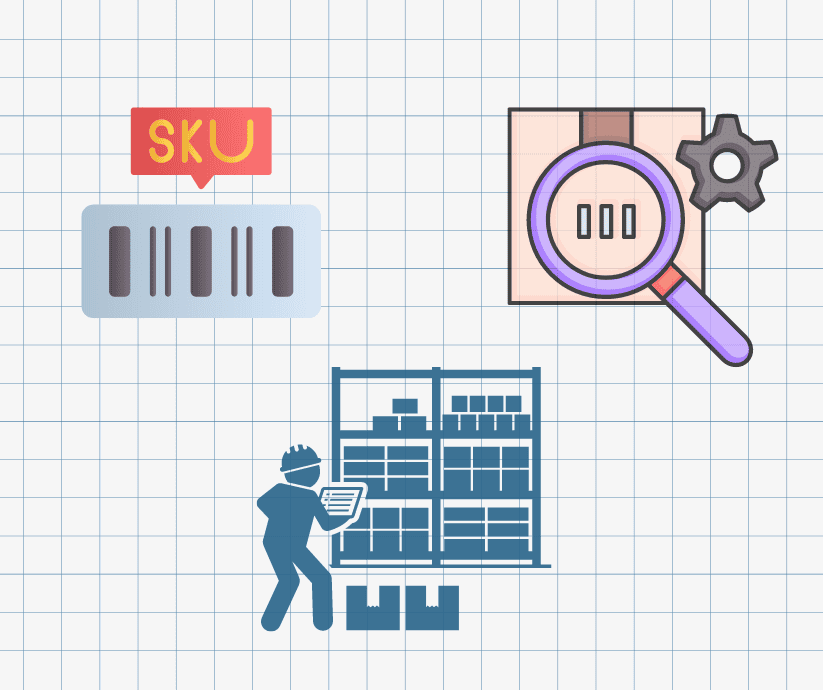
What is an Item Number or SKU Number?
What is an Item Number or SKU Number?

If you are a distributor, manufacturer, or even a service provider, you have probably heard of an “Item Number” and “SKU Number”. These unique identifiers play a crucial role in organizing products, tracking inventory, and streamlining business operations. But what exactly are they, and what types of items do they categorize? This blog will delve into the specifics of Item Numbers and SKU Numbers, explaining their significance and the various types of items they can classify. We will also highlight the importance of SKU and Item Numbers for distribution and manufacturing, and how Kechie Inventory Management Software can efficiently manage these for your business.
Item Number or SKU Number, what are they?
An Item Number, also known as a Stock Keeping Unit (SKU) Number, is a unique identifier assigned to each product in a retailer’s inventory. This alphanumeric code helps businesses track and manage their inventory efficiently. By using SKU Numbers, companies can quickly locate items, track stock levels, and streamline the reordering process.
The Importance of Item Numbers and SKU Numbers
- Inventory Management: Item Numbers help in maintaining accurate inventory levels, preventing overstocking or stockouts.
- Sales Tracking: SKUs allow businesses to monitor sales patterns and identify popular products.
- Efficiency: These identifiers enhance operational efficiency by simplifying the sorting and locating of products.
- Customer Experience: Accurate inventory management leads to better customer satisfaction by ensuring product availability.
Types of Items Classified by SKU Numbers
1. Consumer Goods
Consumer goods encompass a wide range of products, including electronics, clothing, food items, and household goods. Each item in this category has a unique SKU to distinguish it from similar products.
2. Raw Materials
Raw materials used in manufacturing are also assigned SKU Numbers. These can include metals, plastics, fabrics, and other essential materials needed for production.
3. Components and Parts
For businesses dealing with machinery, electronics, or vehicles, components and parts are crucial. Each part, no matter how small, is given an SKU to ensure accurate tracking and inventory management.
4. Finished Goods
Finished goods are products that have completed the manufacturing process and are ready for sale. These items, ranging from furniture to packaged food products, are identified with specific SKUs to streamline sales and inventory control.
5. Services
Although not physical items, services can also be assigned SKU Numbers. For example, in a spa or salon, different services like massages, haircuts, or manicures can have unique SKUs for efficient booking and sales tracking.
6. Digital Products
Digital products such as software, eBooks, and online courses also use SKUs for inventory and sales management. Each digital product is given a unique identifier to simplify the sales process and customer access.
7. Consumable Products
Consumable products, such as cleaning supplies, toiletries, and food and beverage items, are typically used up and replaced regularly. Assigning SKUs to these items helps in tracking usage rates, managing reordering processes, and ensuring consistent availability.
How to Create Effective SKU Numbers
Creating effective SKU Numbers involves a systematic approach to ensure each code is unique and easily identifiable. Here are some tips for creating SKUs:
- Consistency: Use a consistent format across all products.
- Simplicity: Keep SKUs simple and avoid overly complex codes.
- Relevance: Ensure the SKU includes relevant information, such as product type, size, and color.
- Uniqueness: Each SKU should be unique to avoid confusion and errors in inventory management.
Kechie Inventory Management Software
Kechie Inventory Management Software can streamline the creation and management of all SKUs and items. This powerful tool offers an intuitive interface for generating unique SKUs, tracking inventory levels, and managing product details. The addition of barcode capability further boosts efficiency and productivity, allowing for quick and accurate scanning of items reducing manual entry errors, and speeding up the inventory process. By Leveraging Kechie Inventory Management Software with barcode functionality, businesses can enhance their inventory control, improve overall efficiency, and free up valuable resources for other critical tasks.
Conclusion
Item Numbers and SKU Numbers are vital components of efficient inventory management and business operations. By understanding what they are and how to use them effectively, businesses can enhance their organizational processes, improve customer satisfaction, and streamline sales. Whether dealing with consumer goods, raw materials, consumable products, or digital products, assigning the right SKU to each item ensures accurate tracking and management.
Connect with us today, to learn more about how Kechie Solution has the tools for all your business needs. Let our expert team guide you through the process and help you discover the transformative potential of Kechie solutions.


The Difference Between Inventory Management & Inventory Control
Inventory Control and Inventory Management
Similar but ultimately different
Regardless of the industry that your business is in, one of the universal truths of operating a successful business is optimized inventory management and control of inventory. While the terms can seem alike initially, their few similarities become overshadowed by their core functions. This dichotomy isn’t a bad thing. Experts agree that proper inventory management involves inventory control methods; the two must work together to optimize their operations fully. This goal can only be accomplished through accurate inventory management to reap the full advantages of an inventory control system.

The Difference Between Inventory Management and Inventory Control
Let’s try an analogy first. Inventory management is responsible for the broad spectrum of tasks involved in restocking and regulating inventory. Similar to grocery shopping for your family. Ideally, you would purchase for a week or two at a time to not waste any food. While also consider your home’s needs and wants, like a company’s customer base generating supply and demand.
In contrast, you begin to plan meals and put the like items together in the freezer, pantry, and fridge. The process of creating meals and putting the food away is the same as inventory control. Ultimately, it all involves controlling the inventory on hand. At the same time, inventory management is the method of replenishing stock, forecasting supply and demand, along with a broad array of other tasks.
Inventory Control In Different Industries
One of the primary objectives of inventory control is to optimize the items already stocked. One of the advantages of an inventory control system is all about knowing what you have inside and out. Knowing inventory levels, locations, what condition things are in, and much more. All these factors can significantly affect the way manufacturing and distribution companies, in particular, operate.
For example, small to medium businesses can have multiple tiers of inventory such as consumable items like toilet paper and copy paper, raw materials like metal and wood, finished food sale items, and potentially many other forms of inventory based on the business. Distribution companies sometimes use unique categorization for inventory items based on size, color, expiration date, and other factors. Knowing how to group inventory based on different departments’ data gives businesses the edge in this fast-paced, next-day delivery world.
These methods are not exclusive to manufacturers and distributors. Similarly, nonprofit and food-based businesses utilize inventory control methods but with added conditions and parameters. Nonprofit companies are required by law to document nearly every action taken by their business, especially when it comes to their accounting and financing. Providing accurate financial reports for a nonprofit can be a huge hassle. When a nonprofit uses apt control methods, tracking stock and other assets helps optimize the allocation of its limited funding. Additionally, food-based businesses like restaurants and food distribution companies that operate seasonal inventory use different inventory methods for various cost-saving measures. Inventory control, when executed correctly, can provide crucial insight into supply chains and inform every department in a business.
Advantages of Inventory Control System
There’s no doubt that successful businesses employ proper inventory management, but can you accomplish that without a suitable inventory control system? After all, inventory control is all about optimizing the inventory you have in stock. Can you expect your inventory to work for you if you aren’t in control of it? To use another food analogy, in professional kitchens, they use a concept called mise en place, which translates to “everything in its place.” In inventory management, mise en place is inventory control, making sure the inventory is in its place.
Sadly, this is not always the case. Experts have estimated that approximately 43 percent of small businesses don’t track their inventory at all. As a result, they are missing out, to say the least, missing out on potential profit, minimizing waste, and increased customer satisfaction. How does inventory control accomplish those? By integrating with inventory management software. They are two sides of the same coin and genuinely complete one another. By using even simple common sense inventory management and control methods such as FIFO (first-in, first-out) and LIFO (last-in, first-out), businesses of all kinds can operate with total efficiency.
What To Look For

While it can be overwhelming, there are some features that you want to look at regardless of the industry. Those include:
- Automated Tasks: Thanks to modern advances in AI technology, automating various inventory tasks has never been more straightforward. The key to efficiency is ensuring that time-consuming or tedious activities are automating their execution.
- Comprehensive Reports: Inventory management and control work in tandem. Having a robust array of reports will inform you of when things are out of sync and provide a better understanding of day-to-day operations.
- Regular Auditing: By running periodic inventory audits, businesses can identify issues before they become problems.
- Advanced Tracking: Software should aid a business in tracking their products by any categorization they need, by site, location, serial number, lot, date, and more.
- Other Features: These should be based on your industry and include multiple location management, serialization, handheld scanner connectivity, and different software integrations.
Experience the Kechie Difference
At the very heart of the Kechie ERP is the Inventory Management module. A robust piece of software that manages not only the most complex and unruly warehouses but comes fully integrated with other modules to become an overall business improvement system. Kechie is cloud-based, allowing businesses to manage and control inventory from any web browser-enabled device. The team of experts at My Office Apps strives to ensure the success of all our users. Contact us today to schedule a demo and see how we can help improve your business today.

Secure ERP Credit Card Processing Solutions
Two Critical ERP Challenges with Credit Card Processing Systems
In today’s always on world, seamlessly accepting online payments is no longer a differentiator but a basic success requirement for manufacturers, distributors, and service businesses. This means as part of your ERP system you must be able to accept credit card payments from your customers. Credit card sales allow your business to easily increase the size of potential sales, reduce the labor associated with sending out invoices, and improve cash flow.
Accepting a credit card for payment, however, introduces two critical risks to the business – fraud and operational complexity.
At the top of every business owners list should be security. Developing a security strategy is especially important today because of the increasing amount of attempted fraudulent charges. The loss of trust from stolen identity or criminal transactions will have many years of impact beyond a bad transaction.
In order to provide the highest levels of security, credit card payments must be encrypted. In addition, to prevent the possibility that a malicious person gains access to a customer’s account and steals their credit card information, no credit card information should be stored in an ERP system.
How is this done? Instead of storing a customer’s credit card information, the system can use a concept of tokens through a credit card processing company utilizing the PCI (Payment Card Industry) security standard.
These companies create an account for the customer and send your business a token that you store with the customer’s account information in your ERP system. Every time the customer orders, the token is sent to and verified by the credit card processing company. Once the token is verified, the transaction is approved without having to enter or store the credit card information on your site. Follow-on and add-on sales happen just as quickly.
Another risk of accepting credit card payments is operational complexity. Back end ordering, shipping, and accounting systems need to be synchronized with the processing of the payment. Otherwise, manual accounting and auditing practices will be required to match invoice with payments, issue refunds, or answer customer questions. Many businesses have had to implement expensive, complicated programming efforts to interface their business to these credit card processors.
In order to make it easy for you to accept credit cards and not have to worry about possible issues, My Office Apps has established partnerships with two well-respected credit card processing companies. We’ve invested in developing a seamless integration between our cloud-based Kechie ERP software and their credit card processing platforms. This tight integration provides the highest level of security while eliminating operational risk and the need for your business to initiate expensive software development to match payments with orders or manage returns and RMAs.
These two companies are CardConnect and Century Business Solutions. We have incorporated their token system into the Kechie cloud ERP software. Both companies provide highly secure transactions that are compliant with the PCI security standard.
Providing a built-in interface to credit card processing is another example of My Office Apps’ commitment to incorporate innovative features using partnerships and smart algorithms in the Kechie ERP system. Our goal is to provide the best ERP solutions for small and medium sized businesses using the latest techniques in order to help make our clients more efficient and profitable. For more information, you can visit www.myofficeapps.com or better yet, call us at (714) 486-1487 and ask us to schedule a demo so we can show how we can help solve your business issues you face, both today and tomorrow.
About My Office Apps, Inc.
My Office Apps, Inc. (MOA) is a leader in business improvement software solutions to automate your organization. Building on three decades of software design and development, MOA delivers Kechie™, a transformative business tool. Kechie is a fully integrated Enterprise Resource Planning Software as a Service (SaaS) platform with a simplified user experience and the latest in cloud technology. It is quick and easy to implement without the expensive price tag. Sold in separate packages – inventory and warehouse management (CRM, Sales, Procurement, Logistics included), manufacturing, finance – or a fully configured ERP system to include all of these individual tools. Kechie is easily configured to the scalable needs of your growing business. For more information on managing your business processes more efficiently and effectively, visit www.myofficeapps.com.
###


Business Dashboard: 4 Management Tips from Warren Buffett
Business Dashboard: 4 Management Tips from Warren Buffett
The billionaire Berkshire Hathaway CEO has offered some sage advice over the years. Every year, Berkshire Hathaway CEO Warren Buffett writes a letter to the company’s shareholders. Although the letter is mainly about performance of the business, it’s also packed with sage advice from Buffett’s 60-plus-year career. Here are some of his best management tips from the past decade.
1. Base decisions on business needs, not fads.
In his 2014 shareholder letter, Buffett wrote: “That old line, ‘The other guys is doing it, so we must as well,’ spells trouble in any business.”
2. Recognize your employees.
Every shareholder letter from the last decade ends with Buffett thanking his team. “I regularly extol the accomplishments of our operating managers,” he wrote in his 2011 letter. “They are truly All-Stars.”
3. Don’t surround yourself with enablers.
CEO’s keen to close a deal seldom seek dissenting views, Buffett wrote in 2020. “It would be an interesting exercise for a company to hire two ‘expert’ acquisition advisors, one pro and one con, to deliver his or her views on a proposed deal to the board.”
4. Prepare ahead to avoid debt.
“I never will operate Berkshire in a manner that depends on the kindness of strangers,” Buffett wrote in his 2017 letter. “Or even that of friends who may be facing liquidity problems of their own.” Instead, he suggests, build a cash reserve for lean times. Or, as the billionaire calls it, a “cookie jar” fund.
Buffett has employed a laissez-faire or free reign approach to managing his company. It’s a style that allows employees to carry out tasks without much guidance from leaders. Much freedom is given to the employees to make the right decision about what they are going to do. With Kechie™ ERP, management decisions can be swift and powerful with real-time information available at your fingertips. Let us help you make meaningful and prosperous management decisions to grow your business. Visit myofficeapps.com and schedule a demo today.
4 Free Management Tips From Warren Buffett’s Annual Shareholder Letters. (2020, March 4). Retrieved from Management Tips From Warren Buffett’s Annual Shareholder Letters
About My Office Apps, Inc.
My Office Apps, Inc. (MOA) is a leader in business improvement software solutions to automate your organization. Building on three decades of software design and development, MOA delivers Kechie™, a transformative business tool. Kechie is a fully integrated Enterprise Resource Planning Software as a Service (SaaS) platform with a simplified user experience and the latest in cloud technology. It is quick and easy to implement without the expensive price tag. Sold in separate packages – inventory and warehouse management (CRM, Sales, Procurement, Logistics included), manufacturing, finance – or a fully configured ERP system to include all of these individual tools. Kechie is easily configured to the scalable needs of your growing business. For more information on managing your business processes more efficiently and effectively, visit www.myofficeapps.com.
###


World War 3.0: Humans vs. Artificial Intelligence
World War 3.0: Humans vs. Artificial Intelligence
Today, artificial intelligence is a household name and sometimes even a household presence. (Hi, Alexa!).
While artificial intelligence’s acceptance in mainstream society is a new phenomenon, it is not a new concept. The modern field of artificial intelligence came into existence in 1956, but it took decades of work to make significant progress toward developing an artificial intelligence system and making it a technological reality.
 With all these new artificial intelligence use cases comes the daunting question of whether machines will force humans into obsolescence. The jury is still out. Some experts vehemently deny that artificial intelligence will automate so many jobs that millions of people find themselves unemployed, while other experts see it as a pressing problem.
“The structure of the workforce is changing, but I don’t think artificial intelligence is essentially replacing jobs,” said Dr. Hossein Rahnama, founder and CEO of artificial intelligence concierge company Flybits and visiting professor at the Massachusetts Institute of Technology. “It allows us to really create a knowledge-based economy and leverage that to create better automation for a better form of life. It might be a little bit theoretical, but I think if you have to worry about artificial intelligence and robots replacing our jobs, it’s probably algorithms replacing white-collar jobs such as business analysts, hedge fund managers and lawyers.”
Co-founder and CTO of Nara Logics Dr. Nathan Wilson said the shift toward artificial intelligence-based systems will likely cause the economy to add jobs that facilitate the transition.
“Artificial intelligence will create more wealth than it destroys,” Wilson said, “but it will not be equitably distributed, especially at first. The changes will be subliminally felt and not overt. For example, a tax accountant won’t one day receive a pink slip and meet the robot that is now going to sit at her desk. Rather, the next time the tax accountant applies for a job, it will be a bit harder to find one.”
Wilson said he anticipates that artificial intelligence in the workplace will fragment long-standing workflows, creating many human jobs to integrate those workflows. Other experts are not as sure about where the new jobs will come from once artificial intelligence becomes ubiquitous.
Whether rosy or rocky, the future is coming quickly, and artificial intelligence will certainly be a part of it. As this technology develops, the world will see new startups, numerous business applications and consumer uses, as well as the displacement of certain jobs with the creation of entirely new ones.
Let’s embrace the future and replace the past. At My Office Apps, we are incorporating elements of artificial intelligence into our software; not to replace people, but to free them up so they can create more value for your business. If we can eliminate the drudge work for your employees, such asentering routine data into a spreadsheet in favor of spending more time talking with customers, it is a win-win situation for everyone. Call us to see how Kechie™ could solve your business process problems and provide demonstrable value. Or visit us at www.myofficeapps.com to schedule a demo today.
Uzialko, A. (2019, April 22). How Artificial Intelligence Will Transform Business. Retrieved from https://www.businessnewsdaily.com/9402-artificial-intelligence-business-trends.html
About My Office Apps, Inc.
My Office Apps, Inc. (MOA) is a leader in business improvement software solutions to automate your organization. Building on three decades of software design and development, MOA delivers Kechie™, a transformative business tool. Kechie is a fully integrated Enterprise Resource Planning Software as a Service (SaaS) platform with a simplified user experience and the latest in cloud technology. It is quick and easy to implement without the expensive price tag. Sold in separate packages – inventory and warehouse management (CRM, Sales, Procurement, Logistics included), manufacturing, finance – or a fully configured ERP system to include all of these individual tools. Kechie is easily configured to the scalable needs of your growing business. For more information on managing your business processes more efficiently and effectively, visit www.myofficeapps.com.
###

Still Holding the Hands of Your Sales Team?
Still Holding the Hands of Your Sales Team?
Let Kechie Provide You with an A.I. Sales Coach
Don’t you wish you could watch over every single salesperson on every single sales call and give them tips on how to sell more? The Kechie™ ERP software provides an equivalent capability called Upsales, using artificial intelligence-like techniques to provide real-time tips to a salesperson when they are in discussion with a prospect.
 The Upsales feature provides coaching to make it easier for salespeople to sell add-on products when talking to their customers. Oftentimes, the most profitable products may not be products a customer sets out to purchase, but rather a secondary product to accompany the purchase. For example, if a computer salesperson is talking to a customer about purchasing a laptop computer, he/she might suggest they also include a spare battery and a laptop case with the order and increase the overall revenue and margin from the sale.
First, the Kechie Inventory module allows management, or product manager, to program Upsales links between products that pair naturally together. These links are the basis for the suggestions of additional items to suggest when selling. Secondly, a new icon appears in the Sales Order Entry module when a salesperson is entering the order for the first item. This icon reminds the salesperson can suggest additional products to the customer. When clicked, a popup screen appears with additional accessories or add-ons to the sales order. If the customer agrees, the salesperson can make this addition with a single click.
Smart algorithms and A.I. technology are examples of features within the Kechie ERP system to enhance efficiency and profitability for companies. Our goal is to provide the best solutions for small and medium-sized businesses using the latest techniques in order to contribute to the success of our customers. For more information, you can visit www.myofficeapps.com, or better yet, call us at (949) 486-1947 and ask us to schedule a demo so we can show how we can help solve your business issues you face, both today and tomorrow.
###

Improve business efficiency with Artificial Intelligence
Are Your Employees Spending Too Much Time on the Hamster Wheel?
 In previous blogs, we described how Artificial Intelligence techniques (AI) in an ERP system can help improve efficiency and accuracy in your operations. It can also free up employee resources with extra time for creative activities to add value for your business. In this blog, we will describe one feature in our Kechie™ ERP system that uses AI techniques to automatically generate a whole series of new part numbers.
In any business, a critical item used in tracking almost every transaction is the Part Number or SKU (Stock Keeping Unit). Part numbers are used in sales orders, purchase orders, manufacturing, inventory tracking, invoicing and everywhere in between. The use of part numbers creates differentiation between multiple items for ordering, picking and packing the exact item requested by the customer. Many companies have thousands (or millions) of part numbers in their system. Managing this giant mass of data can become impossible without strong processing software to assist along the way.
New part number creation is one activity that can be quite time consuming for your staff, particularly when a large number of new part numbers need to be added at the same time. For the apparel industry, this can be a daunting task. For example, a buyer wants to add a new style shirt to the inventory. The shirt is available in long-sleeved and short-sleeved, classic and slim fit, sizes include extra small, small, medium, large, extra-large, and available in the sixteen colors. That’s 320 new sku’s to be added to the system. One-by-one, an employee sits in front of a screen and adds new parts numbers – perhaps a multiple day project. Is there a better use of this resource?
Here’s where a built-in intelligence can save the day. Kechie delivers a function that can automatically create part numbers and add them to the system. An employee can now focus on descriptions and selling features for a quick-to-market process rather than being bogged down with keystrokes. The artificial intelligence features in Kechie not only help set up new products – but can help your sales staff to up-sell features and products to maximize profitability. More will be revealed on this feature in coming blogs.
My Office Apps, Inc., a business process improvement company, is committed to providing continued improvements and incorporating various advanced AI techniques in our Kechie ERP software. Our goal is to provide the best processing solutions for small and medium sized businesses in order to contribute to the success of our customers. In the coming weeks, we will post additional articles that describe some of the specific AI features present in the Kechie ERP software and also provide a road map for other features that we expect to implement in the future. Our focus is not to just provide AI for AI’s sake, but rather to implement practical AI functions that can make a real difference in your business. For more information, you can visit www.myofficeapps.com or better yet, call us at (949) 486-1947 and ask us to schedule a demo so you can view these features for yourself.
###

WFH: Chapter 2 - The Benefits Outweigh the Risks
Working from Home Series
Chapter Two: The Benefits Outweigh the Risks
We know that many of you are working hard to adapt to the current coronavirus situation. Some companies, particularly those in health, medical supplies, or food distribution business, may be faced with a very rapid increase in demand. You are likely struggling through the logistics on how to handle it. A great many companies are shifting to a Work-From-Home (WFH) mode for their employees. They are learning and improvising new techniques to stay as productive as possible, even when not all together in the same office.
This current crisis will eventually pass. Solutions in the forms of treatment protocols and vaccines will be developed to defeat the virus. But when it is all over, companies will not just revert back to doing business the same way they did before. Businesses will want to incorporate many of the things they learned during the crisis to be more productive, efficient, and flexible than before. The benefits that are expected to come out of this pandemic will change the way we live and play for the better.
Benefits to Society
When millions of commuters no longer commute, traffic jams will smooth out. The climate may improve with fewer emissions of greenhouse gasses. Additionally, for those areas which are experiencing high housing prices, work from home will allow workers to live farther away from the main office. Suburban areas tend to have lower housing costs. Our future will see a reverse shift of populations in crowded cities.
Benefits to Employers
Those people who succeed in business do so because they always think several steps ahead. Strong companies will trudge through the pandemic and florish. Flexibility sets your company up for success Employers who were previously reluctant to allow work from home may also observe the productivity benefits and no longer object to it. With less space required for corporate offices, smart employers will save money by downsizing square footage while receiving equal or greater productivity.
Benefits for Employees
Simply by eliminating the commute to and from the office each day, workers will have more time available. Many will find that they achieve even higher productivity working from home because there are fewer interruptions or time-wasting meetings. The usage of video teleconferencing software such as Cisco Webex, Zoom, or GoToMeeting is exploding and many users are downloading this software and learning to use it for the first time. The use of other tools such as team collaboration software like Microsoft Teams and Slack is increasing as well.
The key to differentiating between a workplace fad and an economic strategy lies in the hands of the businesses. If corporate leaders throughout the world believe remote work is beneficial to the sustainability of their brand, then they’ll invest in the development of it as a resource. In other words, if there is value in telecommuting for organizations, there is value for the world.
The Kechie™ ERP solution was designed to facilitate remote work. Based in the cloud, it can be accessed from anywhere that has an internet connection via desktop, mobile devices including smartphones and tablet computers. It is simple and intuitive to use and allows large teams to share important business data through the data bases in the system. Relevant data from each of the modules is automatically shared so that people working in other departments can use it, if needed. No more walking over to the next aisle to ask a fellow employee what is happening. Everything is recorded in the system.
As a business process improvement company, My Office Apps Inc. remains committed to delivering beneficial software tools to help businesses today and tomorrow. For more information, you can visit www.myofficeapps.com or better yet, call us at (949) 486-1947 and ask us to schedule a demo. Let us show you how we can solve your business challenges during this pandemic and moving forward.

WFH: Chapter One - The Dog will Bark during your Meeting
Working from Home Series
Chapter One: Your Dog will Bark during your Meeting
If you’re a person who spent your pre-pandemic work life in a cubicle or office, right now is a good time to throw yourself into looking on the bright side. Working from home is what you dreamed about every morning and evening when you were stuck in traffic or jammed onto a crowded bus or subway car. Yes, it’s all terrifying and apocalyptic right now — but you can sit in your pajamas all day. You can hang out with your dog. You can make a snack anytime you want, and you can eat it with the TV on in the background.
As companies adjust to the “new normal” of remote work amid the COVID-19 pandemic, maintaining a strong culture and engaging employees is critical. Embracing remote-work opportunities can deliver positive changes to business metrics, including reduced expenses and increased productivity, but requires a willing and motivated shift in perspective from management and staff.
The effectiveness of working from home has been a debated topic for decades. Only about a quarter of the US workforce works from home on a consistent basis. Concerns around productivity, collaboration, connectivity and distractions have all been cited as reasons working from home is not effective.
However, it has taken a pandemic to force a distributed workforce to come together and use online collaboration and technology tools to their full potential. An estimated 900 million people around the world are now working remotely to slow down the spread of the virus. Tools like Zoom, Slack, Google Hangouts, and Microsoft Teams are being rediscovered for their value in supporting video, messaging, conferencing, document sharing, virtual white boarding and many other features.
As we begin to better understand the real potential of working from home, we could now be looking at the future of work. In this new business model, offices may become a fixture of the past and relegated to an occasional pit stop to greet colleagues and process administrative tasks.
The result? Work is actually getting done remotely! And benefits around flexibility and reduced commute times may actually increase productivity and effectiveness. In fact, those of us who work from home often find ourselves overworking. We tether ourselves to our desks and stress ourselves out more at home that we do at work. That’s why it’s important to make sure we take care of ourselves and don’t burn out while working remotely.
During this time, stay connected with friends and build in healthy distractions. Keep perspective and give yourself permission to prioritize information flow. Focus on others and keep moving. Today’s challenges will shift and we will return to a new normal with plenty of new learning and expanded adaptability.
At Kechie™, we can see a shift in how the coronavirus pandemic will permanently change the way business will be done in the future. Our belief is that working from home will become a permanent aspect for many of us. Employers, who were previously reluctant to allow work from home, may also observe the productivity benefits. We will have more to share on this topic in the coming weeks. Until then, please take care of yourselves, follow all the guidelines, and do your best to remain healthy.

Win Big with ERP: AI Solutions to Influence Your Bottom Line
Win Big with ERP: Artificial Intelligence Solutions to influence Your Bottom Line

One of the hottest topics in IT today is Artificial Intelligence (AI). By continuing to automate certain functions using sophisticated AI algorithms, one can free up employee resources for more creative activities that will add further value for your business. Although some believe that AI may replace more mundane jobs, our belief is exactly the opposite. AI will help create an increased number of less-repetitive jobs in your organization making it more innovative, more responsive to your customer’s needs, and more successful. AI will also bring operational benefits with an ability to reduce errors and improve processing times for various transactions that will decrease costs and improve customer satisfaction.
AI incorporates the ability to find trends in a large collection of data and provide insights that may not be obvious to a person looking at gigabytes of data. Many AI programs incorporate the ability to learn from previous activities and allow one to develop more accurate forecasts and predictions.
AI technology can make a positive impact in multiple areas of your business. These can include:
- Inventory Management – By helping to provide more accurate forecasts — optimizing supply chains — figuring out the most efficient way to store the inventory — and tracking product lifecycles, various AI techniques can improve costs, decrease waste, and improve cycle times.

- Production Management – Figuring out the most optimal way to process your backlog in your manufacturing plant can become a horribly complex problem. Utilization of AI techniques can figure out the best ways to select what order to process the jobs in your backlog, which machines to use, maintenance scheduling, and overall logistics as the work-in-process moves through the manufacturing cycle. These optimizations can help decrease the amount of capital equipment needed, improve cycle times, and lower costs.
- Sales – One of the most profitable ways of improving your sales is to implement sophisticated upsells and cross-selling approaches. A sophisticated AI algorithm can help by analyzing, in real-time, what additional products to recommend based on previous customer history and other information.
- Financial Management – Besides automating various financial functions, an AI program can help a financial manager make various key decisions, such as how much cash to keep on hand, whether a capital investment will pay off, and double-check financial statements for accuracy.
- Marketing – A key marketing function is to develop the best and most effective message for your marketing campaign based upon a variety of factors. These include customer demographics, competitive challenges, historical performance, product attributes and many others. Analyzing these factors can involve looking at a great deal of data. By utilizing advanced analytics, a good AI program can help a marketing manager sift through all these factors and create the most effective marketing campaign.

As part of our mission to be a business process improvement company, My Office Apps, Inc. is committed to providing continued improvements and incorporate various advanced AI techniques in our Kechie™ ERP software. Our goal is to provide the best solutions for small and medium sized businesses with the latest techniques to contribute to the success of our customers. In the coming weeks, we will post additional articles that describe some of the specific AI features we have already incorporated into our Kechie software and also provide a roadmap for other features we expect to implement in the near future. Our focus is not to provide AI for AI’s sake, but rather to implement practical AI functions that can make a real difference to your bottom line. For more information, visit www.myofficeapps.com, or better yet, call us at (949) 486-1947 and we will schedule a demo so you can view these features for yourself.