
SAP is the default answer when someone says “enterprise ERP.” But for small and mid-size distributors and manufacturers, that answer comes with a price tag, implementation timeline, and complexity level that rarely matches the reality of a 50-person operation. You are paying for Fortune 500 infrastructure when you need a system that handles 10 things exceptionally well, not 500 things you will never touch.
If you are searching for SAP competitors in 2026, you are likely dealing with at least one of these problems: licensing costs that are disproportionate to your company size, dependence on $200-to-$300-per-hour consultants for every field change, a painful implementation that went over budget and still does not work as promised, or an upgrade pressure from ECC to S/4HANA that feels like a full re-implementation.
This guide compares 12 of the best SAP competitors for 2026, organized by business size: enterprise, mid-market, and small business. We evaluated each platform on total cost of ownership, ease of use for non-technical teams, integration depth, and how well it serves manufacturers and distributors specifically.
Whether you need an affordable SAP alternative with full ERP functionality, a cloud ERP that is lighter and more affordable alternative to SAP, or software like SAP but built for companies with 15 to 250 employees, the SAP competitors chart and reviews below will help you build a shortlist fast.
Top SAP Competitors: Comparison & Ratings Chart
| Software | Best For | Key Strength | Deployment | Starting Price | Setup Time | Capterra Rating |
| Kechie | Manufacturers & distributors | Fully integrated ERP + WMS + MRP | 100% Cloud | Contact for quote | Weeks | 4.7/5 |
| Oracle NetSuite | Mid-market growth companies | Global ERP with multi-subsidiary | Cloud | $$$+/user/mo | 3-6 months | 4.0/5 |
| Microsoft Dynamics 365 | Microsoft-heavy organizations | Native Microsoft 365 integration | Cloud | From $70/user/mo | 3-6 months | 4.0/5 |
| Acumatica | Mid-size (no per-user fees) | Consumption-based pricing | Cloud | Contact for quote | 3-6 months | 4.5/5 |
| Infor CloudSuite | Industry-specific verticals | Deep vertical functionality | Cloud | Contact for quote | 3-9 months | 4.0/5 |
| Epicor Kinetic | Discrete manufacturers | Manufacturing-first ERP | Cloud / On-prem | Contact for quote | 3-6 months | 4.0/5 |
| Workday | Enterprise HR + finance | HCM + financial planning | Cloud | Contact for quote | 3-12 months | 4.2/5 |
| Sage Intacct | Finance-first organizations | Best-in-class cloud accounting | Cloud | Contact for quote | 2-4 months | 4.3/5 |
| ERPNext | Open-source ERP seekers | Free, Python-based ERP | Cloud / Self-hosted | Free; hosted ~$50/mo | 2-8 weeks | 4.0/5 |
| Zoho One | Small businesses wanting app suite | 40+ apps for $45/user/mo | Cloud | From $45/user/mo | Days to weeks | 4.3/5 |
| QAD Adaptive ERP | Complex manufacturers | Supply chain + manufacturing | Cloud | Contact for quote | 3-6 months | 4.0/5 |
| Deacom (ECI) | Process manufacturers | Single-system ERP for process mfg | Cloud / On-prem | Contact for quote | 3-6 months | 4.1/5 |
12 Top SAP Alternatives for 2026
For Small Businesses
1. Kechie – Best Fully Integrated Cloud ERP for Manufacturers & Distributors
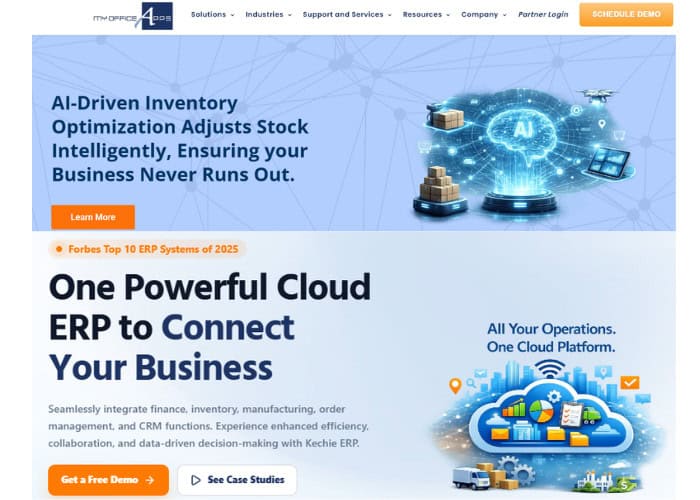
If SAP’s complexity and cost are the core problems, Kechie is the most direct alternative for small to mid-size businesses. We built Kechie as a fully integrated cloud-based ERP specifically for distributors and manufacturers with 15 to 250+ employees.
Every module you would need multiple SAP modules and consultants to configure, inventory management, warehouse management, MRP, order processing, procurement, CRM, logistics, and financials, runs on a single database with real-time visibility across the entire operation.
Product Overview
Kechie delivers multi-warehouse inventory with real-time tracking, lot and serial number management, barcode-driven pick/pack/ship, Material Requirements Planning (MRP), automated cycle counting, integrated GAAP-compliant accounting, and CRM. Every transaction is auditable and drillable from a single interface accessible on any browser, any device, with no local installation.
Pros & Cons
Pros: Truly integrated (no middleware or module-stitching), award-winning customer support with direct access to our engineering team, implementation measured in weeks rather than months or years, unlimited transactions with no per-SKU or per-order surcharges, frequent feature updates, strong track record in distribution and manufacturing.
Cons: Smaller brand than SAP or Oracle, UI is functional rather than visually polished, less suited for companies with fewer than 15 employees who only need basic tools.
Pricing
User-based subscription pricing. Packages available modularly (inventory/WMS, manufacturing, finance) or as a full ERP. One-time fee for implementation, data migration, and training.
Minimum 7 users. Contact us for a custom quote. Compared to SAP, there are no hidden consulting fees, no per-module licensing surprises, and no six-figure implementation budgets.
Setup
Implementation typically takes weeks, not the months or years that SAP deployments require. Our team assigns a dedicated group that blueprints your processes, builds a scope of work, and handles configuration.
Tradeoffs
Reviewers on Capterra, G2, and GetApp consistently highlight ease of use, flexible customization, and support quality as standout strengths.
Some users note a learning curve with advanced configuration, and companies needing highly specialized industry modules (e.g., construction project accounting) should verify fit.
For distributors and manufacturers leaving SAP because of cost, complexity, or consultant dependency, Kechie addresses all three.
➤ See Kechie in action: Schedule your free ERP demo
2. Zoho One – Best Affordable All-in-One Suite for Small Businesses
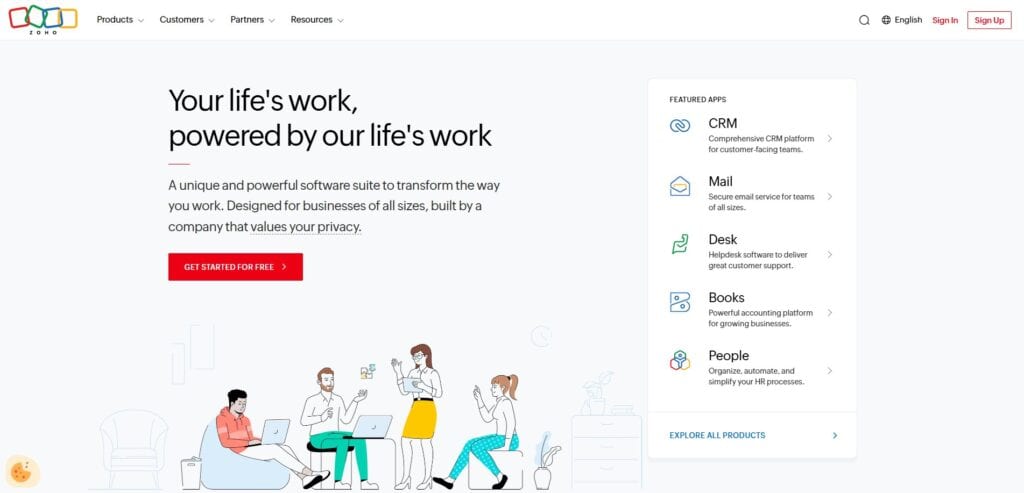
For small businesses that find SAP massively overbuilt and need a broad toolset at a predictable price, Zoho One bundles 40+ applications including CRM, accounting, inventory, HR, project management, and marketing into a single $45/user/month subscription.
Product Overview
Zoho CRM is the centerpiece, with native integration to Zoho Books (accounting), Zoho Inventory, Zoho Projects, and dozens more. The suite covers sales pipeline management, invoicing, inventory tracking, email marketing, and customer support from a clean, modern interface.
Pros & Cons
Pros: Affordable flat-rate pricing, extensive app library, clean UI, strong CRM, good for teams that need breadth over depth.
Cons: Individual apps lack depth for complex operations, inventory and manufacturing modules are basic, limited WMS capabilities, not suitable for multi-warehouse distributors.
Pricing
$45 per user per month (all 40+ apps included). Free trial available.
Setup
Days to weeks. Cloud-native with guided setup.
Tradeoffs
Zoho One is a strong SAP alternative for small businesses that primarily need CRM, basic accounting, and project management. It falls short for manufacturers and distributors needing deep inventory management, MRP, lot tracking, or multi-warehouse operations. For those use cases, a purpose-built ERP like Kechie is the better fit.
3. ERPNext – Best Open-Source SAP Alternative
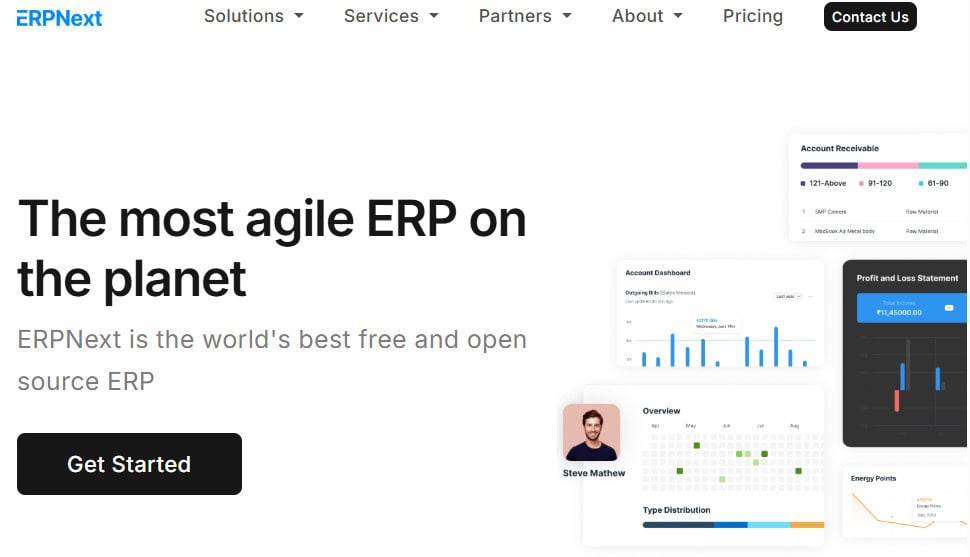
For technically capable teams that want SAP-level functionality without licensing fees, ERPNext is a free, open-source ERP covering accounting, inventory, manufacturing, HR, CRM, and project management. Unlike SAP’s opaque pricing, every feature is available without paid tiers.
Product Overview
Full ERP suite including double-entry accounting, stock management with batch/serial tracking, manufacturing with BOM and work orders, CRM, HR, and project management. Python-based framework that developers can extend.
Pros & Cons
Pros: Completely free and open source, all features included, active community, Python/JavaScript stack is accessible, transparent roadmap.
Cons: Smaller ecosystem, fewer integrations, requires technical expertise for self-hosting, less polished UI, limited official support.
Pricing
Free (self-hosted). Managed cloud hosting from approximately $50/month.
Setup
2 to 8 weeks for cloud. Self-hosted requires Linux skills.
Tradeoffs
ERPNext delivers genuine ERP functionality at zero licensing cost. The tradeoff is a smaller partner network and more self-reliance during implementation. Best for teams with in-house technical capability.
For Mid-Market Companies
4. Acumatica – Best for Mid-Size Companies That Want Unlimited Users
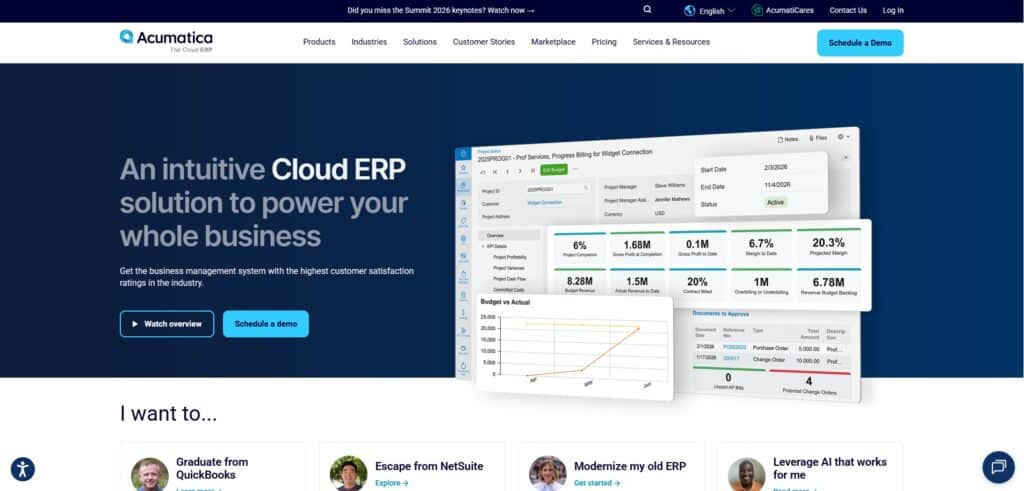
One of SAP’s biggest pain points is per-user licensing that makes system access expensive for warehouse workers, field staff, and occasional users. Acumatica eliminates this with consumption-based pricing that charges by resource usage rather than seat count, making it a compelling SAP alternative for mid-size companies with large teams.
Product Overview
Cloud-native ERP with vertical solutions for manufacturing, distribution, construction, and retail. Includes financials, CRM, inventory, project accounting, and advanced reporting through native Power BI integration.
Pros & Cons
Pros: No per-user fees, strong manufacturing and distribution modules, modern interface, robust API.
Cons: Implementation costs can exceed estimates, customization needs .NET expertise, pricing opaque until partner engagement.
Pricing
Consumption-based (transactions and storage, not user count). Contact Acumatica for quotes.
Setup
3 to 6 months through certified VARs.
Tradeoffs
Acumatica ranks high in customer satisfaction on G2 and offers genuine scalability. The trade-off is higher upfront investment than SMB-focused solutions and implementation quality that varies by partner.
5. Epicor Kinetic – Best for Discrete Manufacturers Leaving SAP
Epicor was built for manufacturing from the ground up. For discrete manufacturers currently on SAP who feel they are paying for supply chain complexity they do not use, Epicor Kinetic provides a manufacturing-first ERP with MRP, production scheduling, quality management, and shop floor control at a lower total cost.
Product Overview
MRP, advanced production scheduling, quality management, shop floor execution, supply chain management, and financials. Strong in automotive, aerospace, industrial equipment, and job shop environments.
Pros & Cons
Pros: Deep manufacturing functionality, strong shop floor and quality modules, industry-specific editions, modern cloud architecture.
Cons: Less strong in distribution-only operations, implementation can be complex, UI modernization is ongoing, partner-dependent.
Pricing
Contact Epicor for quotes. Typically positioned between SMB and enterprise pricing.
Setup
3 to 6 months for standard deployments.
Tradeoffs
Epicor is the strongest SAP alternative for pure manufacturers who need deep shop floor functionality. For distributors or mixed distribution/manufacturing operations, a more broadly integrated system offers better balance.
6. Sage Intacct – Best Cloud Accounting Alternative to SAP Finance
If your primary SAP frustration is the finance and accounting modules, Sage Intacct is the strongest dedicated cloud accounting platform available. It is built for controllers and CFOs who need multi-entity consolidation, revenue recognition, and granular reporting without SAP’s overhead.
Product Overview
Dimensional accounting, automated revenue recognition (ASC 606), multi-entity consolidation, project accounting, and real-time dashboards. The only accounting application endorsed by the AICPA.
Pros & Cons
Pros: Best-in-class financial management, AICPA-endorsed, strong multi-entity support, excellent reporting.
Cons: Not a full ERP (lacks native inventory, WMS, manufacturing), premium pricing, requires integrations for operational workflows.
Pricing
Contact Sage for custom pricing. Premium tier.
Setup
2 to 4 months for standard implementations.
Tradeoffs
Sage Intacct solves SAP’s financial complexity with a focused, best-in-class accounting platform. The tradeoff is that you will still need separate solutions for inventory, warehouse, and manufacturing.
7. QAD Adaptive ERP – Best for Complex, Global Manufacturers
QAD is purpose-built for manufacturing and supply chain operations. For manufacturers who find SAP’s breadth excessive but need genuine supply chain depth, QAD Adaptive ERP provides demand planning, quality management, supply chain visibility, and manufacturing execution in a cloud-native platform.
Product Overview
Manufacturing execution, supply chain planning, quality management, demand sensing, supplier management, and financials. Strong in automotive, life sciences, consumer products, and food & beverage.
Pros & Cons
Pros: Deep manufacturing and supply chain, strong in regulated industries, cloud-native, purpose-built for complex manufacturing.
Cons: Limited brand recognition outside manufacturing, smaller partner ecosystem, CRM and front-office capabilities are basic.
Pricing
Contact QAD for quotes. Enterprise pricing model.
Setup
3 to 6 months depending on manufacturing complexity.
Tradeoffs
QAD is the right SAP alternative for manufacturers who need supply chain sophistication without SAP’s overhead. It is less suited for distributors or companies that need strong CRM and front-office functionality.
For Enterprise
8. Oracle NetSuite – Best Enterprise-Scale Cloud ERP
NetSuite is the SAP alternative that mid-market and enterprise companies gravitate to when they need multi-subsidiary management, global tax compliance, and a platform that handles enterprise complexity without the on-premise infrastructure SAP demands.
Product Overview
Real-time financial consolidation, advanced demand planning, multi-currency and multi-subsidiary support, built-in WMS, SuiteCommerce for B2B/B2C ecommerce. Single cloud platform for financials, CRM, inventory, and HR.
Pros & Cons
Pros: Mature, proven platform, strong financials, global compliance, large partner ecosystem, Oracle backing.
Cons: Expensive (total cost often 3-5x initial estimates), long implementations, steep learning curve, SuiteScript required for customization.
Pricing
Base platform fee plus per-user licensing. Significantly higher than SMB alternatives.
Setup
3 to 6 months standard. Complex deployments extend beyond 12 months.
Tradeoffs
NetSuite matches SAP’s scalability in a cloud-native package. The cost and complexity, while lower than SAP, still exceed what most businesses need or can justify.
9. Microsoft Dynamics 365 – Best for Microsoft-Heavy Organizations
If your company runs on Outlook, Excel, Teams, and Power BI, Dynamics 365 is the logical SAP replacement. Native integration with the Microsoft 365 ecosystem eliminates the middleware and consulting costs that SAP’s third-party integrations require.
Product Overview
Business Central covers financials, supply chain, sales, project management, and manufacturing. Native Power BI analytics and Microsoft Copilot integration for AI-assisted reporting.
Pros & Cons
Pros: Seamless Microsoft integration, strong financials and reporting, large AppSource marketplace, established partner network.
Cons: Per-user costs climb with larger teams, manufacturing module less specialized than dedicated solutions, implementation complexity.
Pricing
Essentials from $70/user/month. Premium (includes manufacturing) from $100/user/month.
Setup
3 to 6 months. Heavily partner-dependent.
Tradeoffs
Dynamics 365 is the strongest SAP alternative for companies already invested in Microsoft. Per-user costs make it less attractive for large warehouse teams compared to consumption-based alternatives like Acumatica.
10. Infor CloudSuite – Best Industry-Specific Enterprise ERP
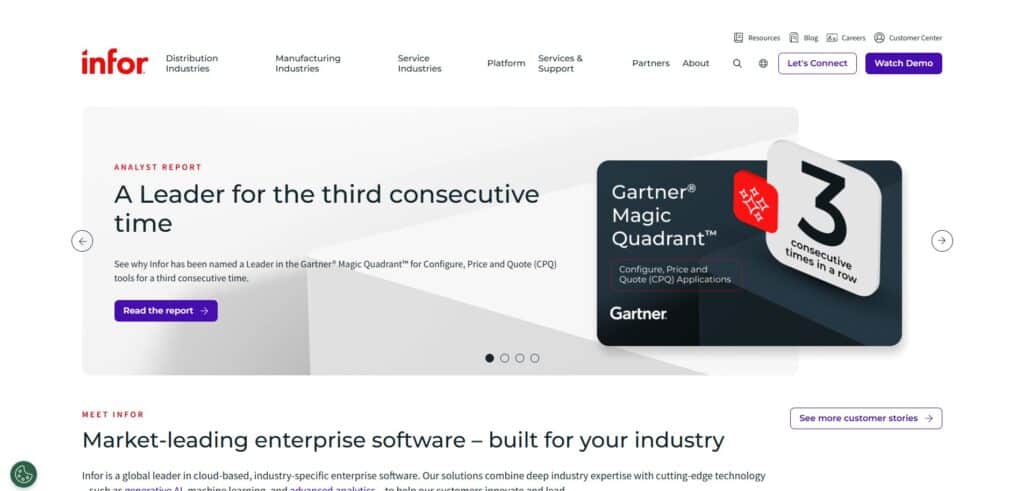
Infor competes directly with SAP in enterprise ERP but differentiates through deep industry-specific functionality. Instead of one platform configured for every industry, Infor offers purpose-built CloudSuites for manufacturing, distribution, healthcare, automotive, and food & beverage.
Product Overview
Industry-specific ERP suites built on AWS with embedded AI/ML through Infor Coleman. Supply chain management, manufacturing execution, financials, and HR. Pre-configured for specific verticals with industry-specific workflows.
Pros & Cons
Pros: Deep industry functionality, AWS-hosted cloud, strong in manufacturing and distribution verticals, less customization required for vertical fit.
Cons: Enterprise pricing, implementation complexity, brand less recognized than SAP in some markets, partner ecosystem smaller outside core verticals.
Pricing
Contact Infor for custom pricing. Enterprise tier.
Setup
3 to 9 months depending on vertical and scope.
Tradeoffs
Infor is a genuine SAP competitor at the enterprise level with stronger vertical pre-configuration. The cost and complexity, while often lower than SAP, are still enterprise-grade.
11. Workday – Best for Enterprise HR and Financial Planning
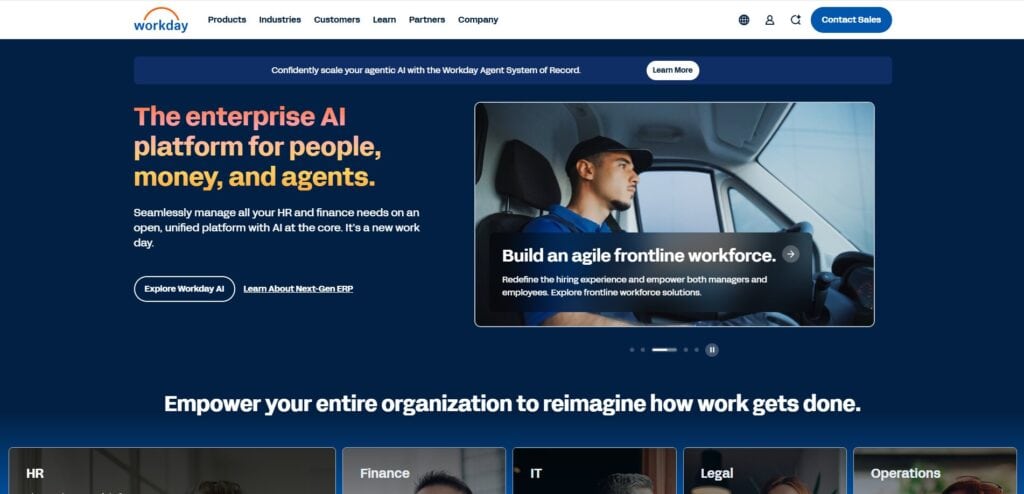
Workday is not a traditional ERP but directly competes with SAP in human capital management (HCM) and financial planning. For enterprises where SAP’s HR and finance modules are the primary pain point, Workday offers a modern, cloud-native alternative.
Product Overview
HCM, payroll, financial management, adaptive planning, analytics, and workforce management. Known for its modern UI, strong reporting, and machine learning capabilities.
Pros & Cons
Pros: Best-in-class HCM, strong financial planning, modern UI, excellent analytics, cloud-native.
Cons: Not a full operational ERP (no inventory, WMS, manufacturing), enterprise pricing, long implementation for large organizations.
Pricing
Contact Workday for quotes. Enterprise pricing model.
Setup
3 to 12 months depending on scope.
Tradeoffs
Workday replaces SAP’s HCM and financial planning modules effectively but does not cover supply chain, manufacturing, or warehouse management. Companies need separate operational ERP alongside Workday.
12. Deacom (ECI) – Best for Process Manufacturers
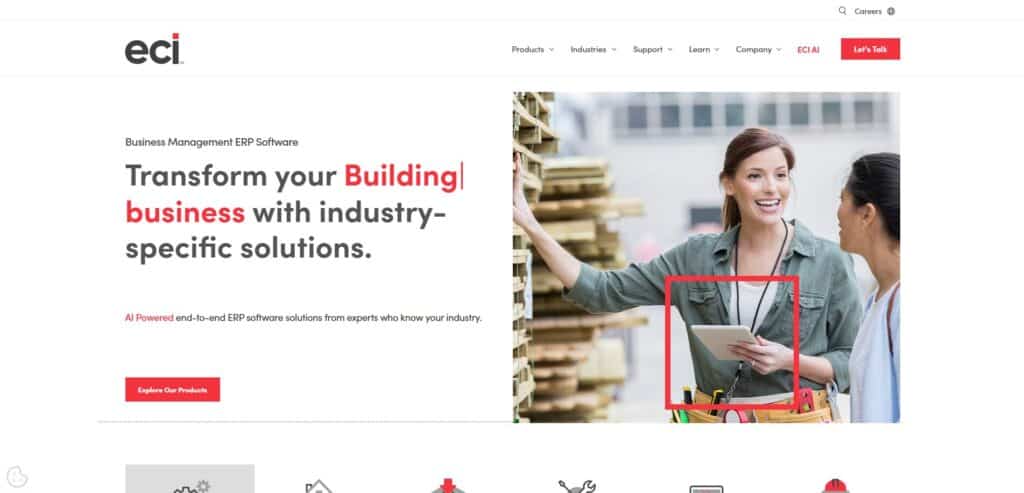
For process manufacturers (chemical, food, pharmaceutical, cosmetics) currently on SAP, Deacom provides a single-system ERP built specifically for batch and formula-based manufacturing, with lot traceability, regulatory compliance, and quality management native to the platform.
Product Overview
Batch management, formula-based manufacturing, lot traceability, quality management, regulatory compliance, inventory, financials, CRM, and warehouse management in a single system. No bolt-ons or third-party modules required.
Pros & Cons
Pros: Single-system architecture (no bolt-ons), strong in regulated manufacturing, native lot traceability, built for batch/formula production.
Cons: Niche focus (process manufacturing only), smaller brand, less suitable for discrete manufacturing or distribution-only operations.
Pricing
Contact Deacom for quotes.
Setup
3 to 6 months for standard process manufacturing deployments.
Tradeoffs
Deacom is the strongest SAP alternative for process manufacturers who need formula management and regulatory compliance without SAP’s cost. Not applicable for discrete manufacturers or distribution companies.
Why Choose an SAP Competitor
The decision to leave SAP typically traces back to a fundamental mismatch: you are paying for and managing a system built for Fortune 500 complexity when your business needs something that works well for the 10 to 15 processes your team actually uses every day. The SAP competition has evolved significantly in the last five years. Modern SAP ERP alternatives now offer comparable functionality for businesses at a fraction of the cost, and the list of competitors of SAP continues to grow as cloud platforms mature.
Disproportionate Cost for Your Company Size
SAP licensing, maintenance fees, consultant rates, and upgrade costs consume a share of revenue that is difficult to justify for a business. By the time you factor in the annual maintenance, periodic consulting, and upgrade cycles, many mid-size companies spend more on SAP than they do on their entire IT department. Affordable SAP alternatives with full ERP functionality exist at a fraction of this cost. For businesses searching for the best alternatives to SAP for small businesses or ERP systems that compete with SAP at a lower price, the savings can be a fraction of total SAP spend.
Consultant Dependency That Never Ends
Every field change, report modification, and workflow adjustment requires a $200-to-$300-per-hour SAP consultant. There is no internal self-sufficiency. The team feels hostage to the partner ecosystem, and every small change takes weeks and thousands of dollars. Modern cloud ERPs are designed for business users to configure, not developers.
Implementation Trauma
SAP implementations for businesses routinely run 2x to 3x over budget and over timeline. The system still does not work as promised after go-live, and the business spent the next year patching gaps. “Burned by SAP” is a buying trigger we see repeatedly across distributors and manufacturers evaluating alternatives.
The S/4HANA Upgrade Pressure
SAP is pushing businesses off older ECC versions to S/4HANA, and the migration cost and complexity essentially amounts to a re-implementation. Many companies are asking the right question: “If we have to start over anyway, why not evaluate something that actually fits our size and budget?”
Low User Adoption
SAP’s interface is too complex for non-technical warehouse, operations, and accounting staff. Training costs are high, turnover resets progress, and the UI feels dated. People default to Excel because SAP is too intimidating for daily tasks. What ERP offers similar features to SAP but is easier to use? Almost any modern cloud ERP designed for operational users rather than IT departments.
No Cloud-Native Access
Running on-premise SAP with limited remote capability is no longer viable. Businesses need cloud-native access from anywhere without VPN headaches or expensive infrastructure maintenance. SAP’s own cloud offerings still feel enterprise-priced and heavy for businesses that need a lighter, more affordable alternative.
How to Choose Your SAP Similar Software
Use this framework to move from SAP frustration to a shortlist of software like SAP that actually fits your business.
Step 1: Quantify What SAP Is Actually Costing You
Calculate total spend: licensing, annual maintenance, consulting hours, internal IT time supporting SAP, training costs for new hires, and the cost of workarounds your team builds in Excel. This number becomes your budget benchmark for alternatives.
Step 2: List the 10-15 Workflows That Matter
SAP does 500 things. You likely use 10 to 15 core workflows daily. Document them: receiving inventory, processing sales orders, running MRP, reconciling financials, managing warehouse picks, tracking lots. Every alternative must handle these workflows natively.
Step 3: Decide Your Size Category
Be honest about company size — but don’t let SAP’s sales team define it for you. If you have 15 to 250+ employees and up to about $250M in revenue, you’re an SMB or lower-mid-market business, and you don’t need Fortune 500 infrastructure to run well.
For distributors and manufacturers in this range, Kechie is the most direct SAP alternative: a full ERP with inventory, warehouse management, MRP, and financials in one system, delivering enterprise-level capability at a fraction of SAP’s cost. At the smaller or simpler end, suite tools like Zoho One or open-source ERPNext can also work, though they lack the inventory and manufacturing depth Kechie provides. Larger mid-market companies ($250M–$500M) may also weigh Acumatica, Epicor, or Dynamics 365, while true enterprises ($500M+) typically look at NetSuite, Infor, or Workday.
Step 4: Test With Real Workflows, Not Demos
Request demos using your actual scenarios: receiving a shipment, running a cycle count, processing a sales order, reconciling month-end. Involve warehouse staff, accounting, and operations managers. Generic product tours hide usability problems.
Step 5: Verify Migration Path From SAP
SAP data migration can be straightforward or extremely complex depending on customizations. Ask each vendor about their SAP migration experience, typical timelines, data mapping approach, and whether they have done it before. A vendor with SAP-to-their-platform migration experience will save you months of pain.
Key Features to Look for When Exploring SAP Software Competitors
Native Inventory and Warehouse Management
Multi-warehouse support, real-time stock tracking, barcode scanning, lot tracking, and serialization should be native. If you are a distributor or manufacturer, the best SAP alternative must include inventory and manufacturing modules that do not require third-party add-ons.
Integrated Financial Management (GAAP-Compliant)
Multi-state tax compliance, revenue recognition, bank reconciliation, and financial consolidation. Your accounting should not require shadow books in Excel. GAAP compliance is non-negotiable for US-based operations.
Manufacturing and MRP
Material Requirements Planning that calculates what you need, when you need it, and generates purchase order and production recommendations from real-time data. BOM management, work orders, and production scheduling integrated with inventory.
CRM Connected to Operations
A CRM that connects to inventory, orders, and financials in real time. Your sales team should see what is available to promise, and finance should see the full customer picture without switching systems.
Reliable, Native Integrations
Native integration with ecommerce (Shopify, Amazon), shipping/delivery carriers (ShipStation, Onfleet), EDI trading partners, and payment processors. “Native” means vendor-built and maintained, not third-party connectors that break.
Modern, Usable Interface
One of the biggest SAP complaints is the UI. SAP ERP competitors should provide an interface that warehouse staff, operations teams, and accounting can use efficiently without weeks of training. Fewer clicks for routine tasks. Intuitive navigation.
Responsive Support Without Consulting Fees
When your ERP has an issue, you need a support team that responds in hours, not a $250/hr consultant scheduled for next week. Evaluate support models: dedicated account manager, phone support, ticket resolution times. The best alternatives to SAP include support in the subscription, not as a billable add-on.
Cost Comparison: SAP vs. Competitors
| Platform | Licensing Model | Estimated Annual Cost (20 users) | Hidden Cost Risks |
| SAP Business One / S/4HANA | Per user + modules + maintenance | $50,000-$250,000+ (before consulting) | Consulting, upgrades, customization, infrastructure |
| Kechie | Per user, all modules included | Contact for quote; no per-app or consulting fees | Implementation/training (fraction of SAP) |
| Oracle NetSuite | Base fee + per user | $40,000-$100,000+ | Implementation, customization, annual increases |
| Acumatica | Consumption-based | Contact for quote | Partner implementation, scope changes |
| Microsoft Dynamics 365 | Per user ($70-100/user/mo) | $17,000-$24,000+ | Add-on modules, partner implementation |
| Epicor Kinetic | Contact for quote | $30,000-$80,000+ | Customization, vertical modules, partner fees |
| ERPNext | Free (self-hosted) or ~$50+/mo | $0-$1,200 | Internal IT for self-hosting |
| Zoho One | Per user ($45/user/mo) | ~$10,800 | Limited depth forces additional tools |
Which of the Alternatives to SAP Is Right for Your Business?
The right choice depends on your company size, operational complexity, and what specifically drove you to search for SAP alternatives. The SAP competitors list is long, but the SAP biggest competitors break down by market segment. Here is a quick guide to finding a good replacement for SAP based on your situation.
If you are a small to mid-size distributor or manufacturer (15 to 250+ employees) that needs inventory, warehouse management, MRP, and accounting in one system without SAP’s cost, complexity, or consultant dependency, Kechie is the most direct replacement. We built it for exactly this scenario.
If your primary frustration is SAP’s financial modules and you want best-in-class accounting, Sage Intacct solves that problem specifically. If you need an open-source alternative, ERPNext provides full ERP without licensing fees. For companies that want unlimited users without per-seat pricing, Acumatica’s consumption model is compelling.
For enterprise operations ($500M+ revenue) that need global multi-subsidiary management, Oracle NetSuite, Infor CloudSuite, or Microsoft Dynamics 365 provide the scale. Discrete manufacturers should evaluate Epicor Kinetic. Process manufacturers should look at Deacom.
Whichever direction you go, start by quantifying what SAP actually costs you today, list the workflows that matter, and test alternatives with your real scenarios.
➤ Ready to leave SAP? Schedule your free Kechie ERP demo
FAQs
Does SAP have any competitors?
Yes. SAP competes with dozens of ERP providers across every market segment. The most direct SAP competitors ERP buyers should evaluate include Oracle NetSuite, Microsoft Dynamics 365, Acumatica, Infor, Epicor, and Workday at the enterprise and mid-market level. For businesses, systems like Kechie, Zoho One, and ERPNext offer full ERP functionality at a fraction of SAP’s cost and complexity. The SAP ERP competitors landscape continues to grow as cloud platforms mature.
What is the best alternative to SAP?
The best alternative depends on company size. For manufacturers and distributors (15-250 employees), Kechie provides the most direct replacement with fully integrated inventory, warehouse, manufacturing, and accounting in a single cloud system. For mid-market companies, Acumatica or Epicor. For enterprise, Oracle NetSuite or Microsoft Dynamics 365.
What replaces SAP?
Modern cloud ERP platforms replace SAP for businesses that do not need Fortune 500 complexity. The ERP systems that most frequently replace SAP in the SMB space are cloud-native platforms that offer faster implementation, lower total cost of ownership, and interfaces designed for operational teams rather than IT departments.
What are the big 4 companies for SAP?
The “Big 4” SAP consulting firms are Deloitte, Accenture, PwC, and EY, which handle SAP implementations and support for large enterprises. These are not SAP alternatives but rather the consulting firms that charge $200-$300+/hour to configure and maintain SAP systems. For companies looking for alternatives to SAP itself, Oracle, Microsoft, Infor, and Acumatica are the biggest competitors.
Will SAP be replaced by AI?
AI will not replace ERP systems, but it is transforming how they work. Modern cloud ERPs now embed AI for demand forecasting, anomaly detection, automated reorder points, and natural-language reporting. SAP itself is integrating AI through Joule and other tools. The real question for businesses is whether SAP’s AI features justify the cost when lighter platforms offer similar capabilities at a fraction of the price.
What are the top 5 companies for SAP?
The companies that most frequently compete with SAP for ERP market share are Oracle (NetSuite and Cloud ERP), Microsoft (Dynamics 365), Infor, Acumatica, and Workday (for HCM/finance). For Manufacturer or Distributor-focused alternatives, Kechie, Epicor, Sage Intacct, Zoho One, and ERPNext are the leading systems that win business from companies leaving SAP.
Is Kechie ERP software worth its cost?
For distributors and manufacturers leaving SAP, Kechie typically delivers a lower total cost of ownership with faster implementation and less ongoing consulting expense. Caitec doubled their business with 30% less overhead after switching to Kechie, and Computer Memory Solutions achieved 99.9% shipment accuracy. The value is measured in operational efficiency gains, not just software licensing.
Is there a simpler ERP than SAP for mid-size companies?
Yes. Most modern cloud ERPs are simpler than SAP by design. For mid-size companies specifically, Kechie, Acumatica, and Epicor Kinetic provide comparable operational functionality with significantly less complexity, faster implementations, and interfaces built for business users rather than SAP consultants. The key is finding a platform that covers your specific workflows without the overhead of unused modules.
Schedule a Free Demo Today!
See how Kechie ERP can transform your business, save you time, money, and aggravation. Click the button below to schedule your free demo.
Schedule Your Kechie Demo Now!In This Article
-Top SAP Competitors: Comparison & Ratings Chart
-12 Top SAP Alternatives for 2026
-Why Choose an SAP Competitor
-How to Choose Your SAP Similar Software
-Key Features to Look for When Exploring SAP Software Competitors
-Cost Comparison: SAP vs. Competitors
-Which of the Alternatives to SAP Is Right for Your Business?
-FAQs