ERP for Food Services: A Buyer’s Guide to Lot Tracking, Catch Weight, and Traceability (2026)
If a customer, auditor, or retail partner asked you right now to produce every lot number, supplier, and shipment record tied to a single pallet of product — how long would it take your team to answer?
For most growing food and beverage companies, the honest answer is: too long. The information exists, but it lives across a receiving spreadsheet, a production log, a separate inventory tool, and someone’s memory of which truck picked up which order. Pulling it together takes phone calls, manual cross-referencing, and a few hours nobody had budgeted for.
That gap — between having the data somewhere and being able to produce it on demand — is the real operational problem behind food traceability. It shows up during a recall. It shows up when a retailer’s compliance team flags a shipment. And increasingly, it shows up in everyday vendor scorecards, long before any regulator gets involved.
This guide is for teams already evaluating an ERP for exactly this reason. What to look for, what to skip, and how to tell a system built for food and beverage operations from one that was adapted for it after the fact.
Why Traceability Pressure Is Rising Now
Food traceability isn’t a new concept, but the urgency around formalizing it has accelerated from two directions at once.
The first is regulatory. The FDA’s Food Traceability Rule — FSMA Section 204 — requires companies that manufacture, process, pack, or hold foods on the FDA’s Food Traceability List to maintain detailed records called Key Data Elements (KDEs), tied to specific points in the supply chain called Critical Tracking Events (CTEs). When the FDA requests those records, companies have 24 hours to produce them. The original compliance deadline was January 2026. The FDA extended it 30 months to July 20, 2028, and Congress made that extension binding through appropriations legislation.
The second source of pressure is commercial — and it hasn’t moved at all. Major retailers and large foodservice distributors are already enforcing their own traceability and labeling requirements on suppliers, with vendor scorecard penalties and chargebacks for shipments that don’t comply. For a food company selling into mass retail or large distribution accounts, the date that actually matters is often not 2028. It’s whatever your largest customer’s contract already says.
The practical takeaway: the federal deadline is the floor, not the ceiling. Building traceability into how you operate every day — rather than treating it as a project with a 2028 finish line — is what keeps you on the right side of both fronts.
What Traceability-Ready Food Operations Actually Need
Strip away the regulatory language and the operational requirement is straightforward: when a question is asked, the answer should already exist in your system — not need to be assembled.
That requires a specific set of capabilities working together as a single connected record, not as a collection of standalone tools that have to be manually reconciled at the end of the day.
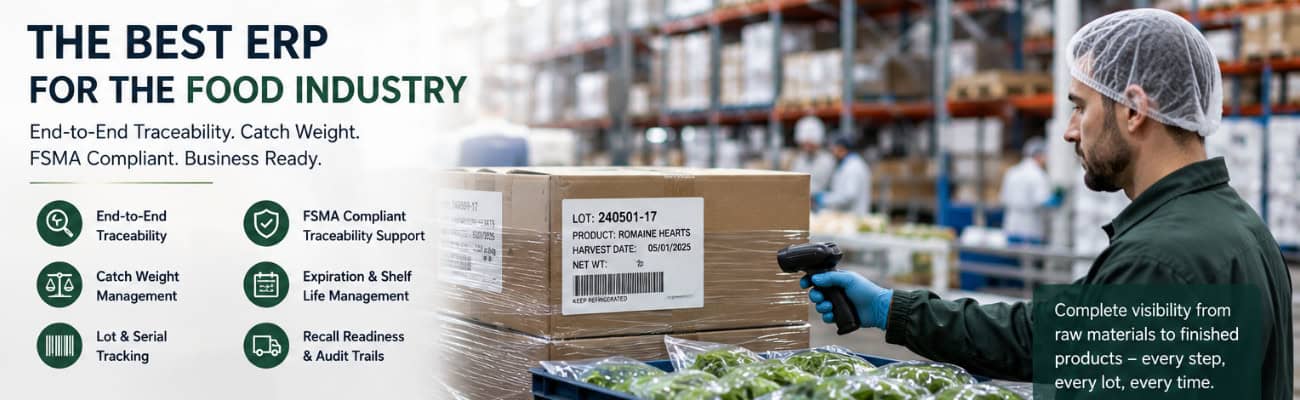
Lot and batch tracking. Every lot needs to be traceable from the supplier it came from, through receiving, production, storage, and shipping, all the way to the customer it ultimately reached — in both directions. If you can’t run that lookup in minutes, you don’t have traceability. You have data.
Expiration and best-use-date visibility. For perishable inventory, date tracking isn’t just a compliance checkbox — it drives real daily decisions about what ships first, what gets marked down, and what gets pulled. That visibility needs to be live, not reconciled at month-end.
Catch weight support. Meat, poultry, seafood, cheese, and other variable-weight products don’t fit neatly into fixed-unit inventory systems. A case might be sold by the unit but invoiced by actual weight, and that weight varies case to case. Without native catch weight handling, the gap between your inventory system and your invoicing becomes a manual reconciliation problem — one of the most common sources of margin leakage and billing disputes in food distribution.
A complete, automatic audit trail. Every inventory movement — who touched it, when, and what changed — needs to be logged automatically by the system, not entered manually by staff. That automatic record is what actually answers a recall question or an auditor’s request, rather than depending on someone’s recollection of what happened three weeks ago.
Real-time visibility from receiving through shipment. Lot numbers, expiration dates, and catch weights are only useful if they update in real time across the whole business. If your warehouse team, production floor, and finance team are each looking at data from a different system, the traceability record has already broken before anyone asks for it.
Why Spreadsheets and QuickBooks Fall Short
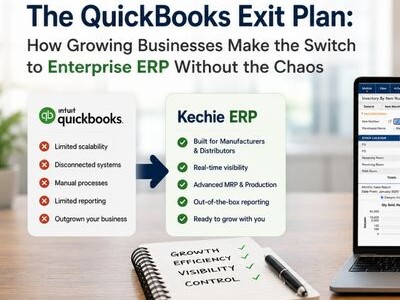
None of this is a knock on QuickBooks — it does what it was built to do, which is accounting. But QuickBooks has no native concept of lot tracking, catch weight, or expiration dates. That’s why so many food companies end up running QuickBooks alongside spreadsheets plus a separate inventory tool, manually reconciling all three.
The problem with that patchwork isn’t that any one piece fails on its own. It’s that no single system has the complete picture — and a complete picture is exactly what traceability requires. For more on when that setup stops being sustainable, see our full breakdown in QuickBooks vs. ERP: When Accounting Software Isn’t Enough.
What to Look for in an ERP for Food and Beverage Companies
If you’re evaluating ERP systems specifically because of lot tracking, catch weight, or traceability requirements, a few pointed questions will tell you quickly whether a system was built for food operations or bolted on after the fact:
- Does lot tracking work natively across every module — inventory, production, and shipping — or only in one place?
- Can the system handle catch weight items without a manual workaround or a third-party add-on?
- Is the audit trail logged automatically by the system, or does it depend on staff remembering to record changes?
- Can you produce a full lot history — supplier to customer — in minutes, not hours?
- Does the vendor have actual food and beverage clients, or is food listed as a supported industry without a real track record behind it?
How Kechie Approaches Food and Beverage Operations
Kechie’s inventory and warehouse management system was built around these requirements from the ground up — not configured for them after the fact.
Lot tracking with expiration and best-use-date filtering, native catch weight support for variable-weight items, serialized inventory tracking, and a complete audit trail logging user, timestamp, and before-and-after values on every transaction are all part of Kechie’s core modules — not separate add-ons you pay for later. Because Kechie runs on a single database, that information is visible in real time across receiving, production, warehousing, and shipping. A lot lookup or a recall response pulls from one place instead of three.
Kechie is recognized as a Forbes Top 10 ERP for 2025 and is used by food and beverage operations — including distribution organizations managing perishable goods at scale — that need the operational foundation traceability requirements are built on.
To be direct about what this does and doesn’t mean: no ERP vendor can certify your business as FSMA 204 compliant. That depends on your written Traceability Plan, your internal procedures, and your supply chain partners — not your software alone. What a system like Kechie provides is the ability to capture the right data at the right points and produce it quickly when it’s asked for, whether the ask comes from the FDA, an internal auditor, or a retail buyer’s compliance team. For more on how Kechie compares to the major alternatives, see our ERP comparison overview.
Implementation Reality for Food and Beverage Companies
Food and beverage operations don’t have the luxury of a long, disruptive rollout. Perishable inventory and live production schedules don’t pause for a software project.
Kechie implementations are handled directly by the Kechie team — not handed off to a third-party VAR — and typically go live in weeks rather than months. Onboarding includes sandbox access for hands-on training before go-live, so your team works in the actual system on your actual workflows before the cutover happens. If your operation runs production in addition to distribution, our manufacturing ERP implementation guide covers the process mapping and data migration steps in depth.
Kechie serves food and beverage companies from roughly $1M to $100M+ in revenue — businesses that have outgrown spreadsheets and accounting software but don’t need (or want to pay for) enterprise-scale complexity. For context on where Kechie fits against larger systems like NetSuite or SAP, see our cloud ERP for distribution guide.
Frequently Asked Questions
What is food traceability software?
Food traceability software tracks inventory by lot or batch from receipt through production and shipment, so a company can quickly identify where a specific lot came from, where it went, and what happened to it along the way. The strongest implementations do this inside a single integrated system — not across separate tools that have to be manually reconciled.
What should an ERP track for food and beverage companies specifically?
At minimum: lot and batch numbers, expiration and best-use dates, catch weight for variable-weight items, and a complete audit trail of inventory movement. These need to update in real time and stay connected across receiving, production, warehousing, and shipping.
What is FSMA Section 204?
FSMA Section 204 is the FDA’s Food Traceability Rule, which requires companies that manufacture, process, pack, or hold certain high-risk foods to maintain detailed traceability records and produce them to the FDA within 24 hours of a request. The compliance deadline was extended to July 20, 2028. However, many major retailers and foodservice distributors are already enforcing their own traceability requirements on suppliers independent of the federal timeline.
Does QuickBooks support lot tracking and catch weight?
No. QuickBooks is accounting software and has no native lot tracking, expiration date management, or catch weight functionality. Companies that need these capabilities typically run QuickBooks alongside separate inventory tools and spreadsheets — which creates reconciliation gaps rather than a single source of truth.
What is catch weight, and why does it matter for ERP selection?
Catch weight refers to products — common in meat, poultry, seafood, and cheese — that are sold by the unit but invoiced based on actual variable weight. An ERP without native catch weight support forces manual reconciliation between inventory counts and invoicing, which is a common source of billing errors and margin loss in food distribution.
How long does it take to implement an ERP with traceability features?
It depends heavily on the vendor and how the system is architected. Implementations that route through third-party consultants and require building traceability functionality on top of a generic system often take three to six months or longer. Kechie implementations, handled directly by the team that built the system, typically go live in weeks.
Does an ERP make a company FSMA 204 compliant?
Not on its own. FSMA 204 compliance depends on a company’s written Traceability Plan, internal procedures, and coordination with supply chain partners — software alone can’t satisfy that. What the right ERP provides is the data infrastructure those requirements depend on: fast, accurate lot lookups and a complete audit trail, produced from real operations rather than reconstructed after the fact.
If you’re earlier in the process and want the broader case for why traceability matters before getting into system evaluation, see Why ERP and Traceability Matter in the Food & Beverage Industry. For more on how Kechie supports food and beverage operations specifically, visit the Kechie Food Services page.
➤ Ready to see how Kechie handles lot tracking, catch weight, and traceability for your operation? Schedule your free Kechie ERP demo.
Schedule a Free Demo Today!
See how Kechie ERP can transform your business, save you time, money, and aggravation. Click the button below to schedule your free demo.
Schedule Your Kechie Demo Now!In This Article
-Why Traceability Pressure Is Rising Now
-What Traceability-Ready Food Operations Actually Need
-Why Spreadsheets and QuickBooks Fall Short
-What to Look for in an ERP for Food and Beverage Companies
-How Kechie Approaches Food and Beverage Operations
-Implementation Reality for Food and Beverage Companies
-FAQs