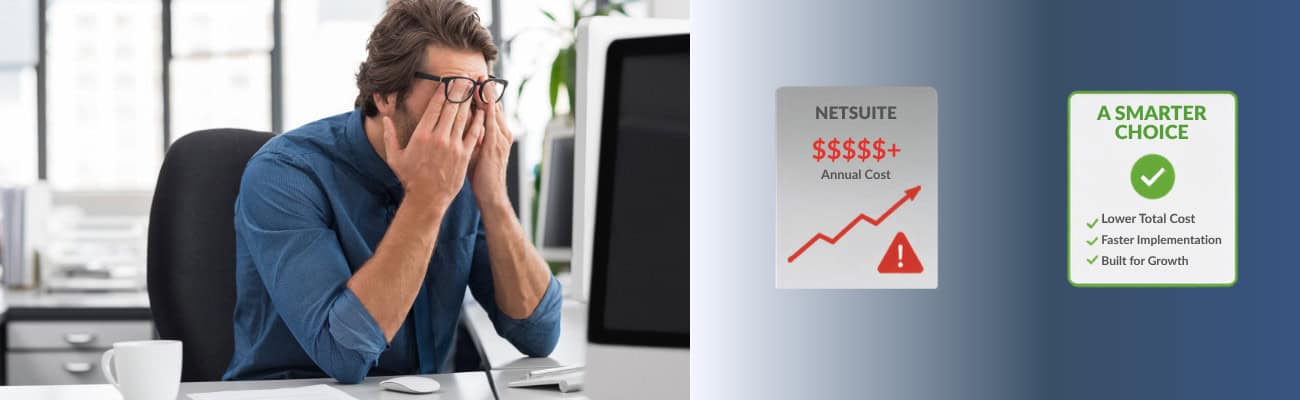
You did everything right. You researched your options, booked the demos, and sat through the presentations. Then the enterprise ERP quotes came in — and the numbers stopped you cold. Six figures just to get started. A year or more to go live. A build-out project before you see a single working report.
If that sounds familiar, you’re not alone. And you’re not out of options.
The Wall Every Growing Business Hits
There’s a moment almost every scaling business reaches — usually somewhere between $5M and $50M in revenue — where the tools that got you here stop being enough.
QuickBooks is straining under the weight of your inventory. Your team is reconciling data between three different systems every Monday morning. You can’t get a real-time picture of your business without pulling spreadsheets from four different places. Orders are slipping through the cracks. Month-end close takes three weeks.
So you do what everyone tells you to do. You start looking at “real” ERP systems. You book demos with the big names — NetSuite, SAP Business One, Microsoft Dynamics, Sage Intacct. The demos are impressive. The sales teams are polished. And then the quotes arrive.
For many growing businesses, those quotes are a full stop.
Enterprise ERP implementations routinely run $75,000 to $250,000 or more — before you factor in the customization costs, the training, and the ongoing support contracts. And that’s before you go live, which can take anywhere from six months to two years.
For a growing manufacturer or fast-moving distributor, that’s not a software purchase. That’s a bet-the-company decision.
So what do you do when you’ve clearly outgrown QuickBooks, but enterprise ERP feels like too much — too expensive, too complex, too long?
That’s exactly the question this article answers.
Why Enterprise ERP Costs So Much
Before we talk about the alternative, it’s worth understanding why enterprise ERP is so expensive — because the answer reveals something important about what you’re actually paying for.
Enterprise ERP systems like NetSuite, SAP, and Dynamics were built for large, complex organizations with dedicated IT departments, implementation teams, and multi-year technology budgets. They are extraordinarily powerful — and extraordinarily flexible. You can configure them to do almost anything.
But that flexibility comes at a cost. Because these systems can do almost anything, they don’t come pre-configured to do any one thing particularly well out of the box. Every workflow, every report, every approval process, every integration has to be designed and built from scratch — on your dime, on your timeline.
You’re not buying software that runs your business. You’re buying a foundation on which your entire operation has to be constructed before anyone can use it. The license fee is just the beginning.
This is why enterprise ERP implementations so frequently go over budget and over schedule. It’s not because the software is bad. It’s because the model requires a construction project before you can move in.
For enterprise companies with IT departments, long planning horizons, and deep pockets, that model works. For a growing business that needs to be operational in weeks and can’t afford a year-long implementation project, it often doesn’t.
The Gap Nobody Was Filling
For years, growing businesses faced a binary choice: stay on QuickBooks and manage the pain, or take the leap into enterprise ERP and manage the risk.
Neither option was great. And for a long time, there wasn’t much in between.
The enterprise ERP space has historically been built for large organizations — too complex and too expensive for growing businesses that need something complete and ready to go. The solutions that did exist were often outdated, clunky, or required nearly as much customization as the enterprise systems they were supposed to replace.
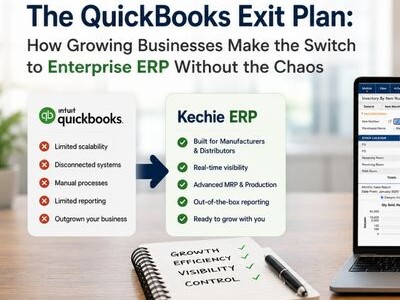
What growing businesses actually needed was something different: a fully integrated enterprise ERP solution with all the functionality — inventory, orders, procurement, manufacturing, finance, CRM, warehouse management — that came ready to use from day one, without a construction project in between.
That gap is exactly what Kechie ERP was built to fill.
What “Out of the Box” Actually Means
The phrase “out of the box” gets thrown around a lot in software marketing. It’s worth being specific about what it actually means — and why it matters so much for growing businesses.
When Kechie says out of the box, it means this: every core business process your company needs is already built, already configured, and already working when you go live. You’re not starting with a blank canvas. You’re starting with a fully functioning enterprise ERP system that’s been purpose-built for businesses like yours.
That includes hundreds of pre-built reports — covering inventory, purchasing, sales, financials, manufacturing, and more — available from day one without any custom development. It includes standard workflows for order management, procurement approvals, warehouse operations, and financial close. It includes integrations with the tools you already use, pre-configured and ready to connect.
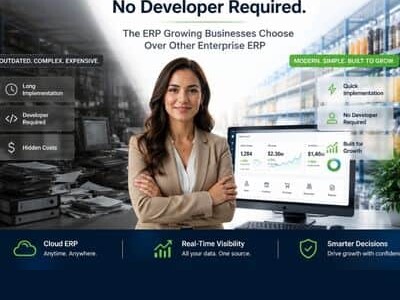
What implementation looks like with Kechie isn’t a construction project. It’s a configuration process. The team works with you to set up your specific products, your specific workflows, your specific team structure — within a system that already knows how to run a business like yours. Most customers are fully live in weeks, not months.
The difference in cost, time, and risk between that model and a traditional enterprise ERP implementation is significant. You’re not paying to have a system built from scratch. You’re paying to get up and running on a system that’s already built.
What Kechie Actually Costs — And What It Includes
We won’t publish specific pricing here because every business is different and Kechie’s team prices based on your actual needs — but we can tell you this: the difference between Kechie’s total cost of ownership and a typical enterprise ERP implementation is dramatic.
Where an enterprise ERP implementation might run $150,000 to $300,000 all-in before you go live, Kechie customers are typically live and operational for a fraction of that — with no surprise fees, no runaway customization costs, and no multi-year implementation timeline eating into your budget.
More importantly, Kechie grows with you. As your business scales — more users, more locations, more complexity — the system scales alongside you without requiring a new implementation or a new round of customization fees.
This is what transparent, predictable enterprise ERP pricing actually looks like in practice.
What You Get With Kechie
Kechie is a fully integrated cloud enterprise ERP solution built for manufacturers, distributors, food and beverage companies, nonprofits, and other product-based businesses ready to scale. Every module below comes ready to use out of the box — no development required. Choose the functionality your business needs today, and add more as you grow. You never pay for what you don’t need.
The Core Kechie Package
Every Kechie customer starts with a powerful, fully integrated foundation that covers the essential operations of your business:
Inventory Management — Real-time inventory tracking, multi-location management, lot and serial number tracking, cycle counting, and automated reorder points. Know exactly what you have, where it is, and when to reorder — without a single spreadsheet.
Warehouse Management (WMS) — Receiving, put-away, picking, packing, and shipping — all managed with barcode scanning support and real-time inventory updates.
Procurement — Vendor management, purchase requisitions, approval workflows, and three-way matching between POs, receipts, and invoices. Eliminate manual processes and catch discrepancies before they become problems.
CRM — Customer and prospect management, sales pipeline tracking, activity logging, and opportunity management — fully integrated with your order management and financials, so your sales team always has the full picture.
Order Management — From quote to cash, fully automated. Sales orders, purchase orders, drop shipments, and returns — all managed in one place, all connected to your inventory in real time.
Logistics — End-to-end visibility across your supply chain, from inbound shipments to outbound fulfillment. Coordinate carriers, track shipments, and manage delivery workflows without leaving the system.
Reporting and Analytics — Hundreds of pre-built reports covering every aspect of your business, available from day one. Inventory, purchasing, sales, financials, logistics, and more — all ready to run without any custom development. If you can imagine the report, you can run it.
RMA (Returns Management) — Handle customer returns, exchanges, and credits cleanly and efficiently — fully connected to your inventory and order management so nothing falls through the cracks.
Built for Enterprise-Grade Operations
Every Kechie transaction is backed by full audit traceability — every change logged with the user, timestamp, and before-and-after values, so nothing is ever a mystery. Real-time data flows across every module so your team is always working from the same current picture. And full access control with user role management means every person on your team sees exactly what they need to — nothing more, nothing less.
The Right Functionality for Your Industry — When You Need It
Beyond the core package, Kechie goes deep where your industry demands it. Lot traceability, expiration date tracking, best-by date management, serialization, catch weight, and apparel variations are all available out of the box. Native integrations with Shopify (two-way sync), EDI, tax, and eCommerce platforms keep your systems connected without manual work. Add-on modules including Financial Management, Manufacturing, B2B Portal, Vendor Portal, Task Management, and Equipment Maintenance can be activated at any time — no new implementation, no build-out, just configuration.
A full list of modules and integrations is available at www.myofficeapps.com — or ask the team during your demo which ones are right for your business.
All of this — ready to go out of the box, configured to your needs, and connected from day one. Start with what you need. Add what you don’t — when you need it.
Who Kechie Is Built For
Kechie is the right fit for businesses that check most of these boxes:
• Manufacturing, distribution, food and beverage, nonprofit, or related industries
• Ready to scale beyond QuickBooks, spreadsheets, or disconnected systems
• Need full enterprise ERP functionality — not just accounting or just inventory
• Want to be live and operational in weeks, not months or years
• Looking for a true enterprise ERP solution with transparent, predictable pricing and no hidden implementation costs
• Value fast, US-based support from a team that knows your business
• Want a native QuickBooks Online integration to transition at your own pace
We believe in straight talk. Kechie is a serious enterprise ERP solution — and we want to make sure it’s the right fit for your business before you commit. That’s exactly why we offer a working demo, not a sales pitch. If Kechie is right for you, you’ll know it. And if it isn’t, we’ll tell you that too.
Real Businesses. Real ROI.
The proof isn’t in the pricing conversation — it’s in what businesses say after they’ve made the switch.
A VP of Operations at a manufacturer and distributor that evaluated four ERP solutions before choosing Kechie put it simply: “Double the business with the same amount of people. We have implemented Kechie and it has provided us a tool to develop business processes that, in the past, were highly manual and time consuming.” Their results backed it up — business volume doubled while overhead dropped by 30%.
An electronics component supplier that moved to Kechie from spreadsheets saw their shipment accuracy climb to 99.9%. Their Senior Director of Business Development said it best: “Kechie adapted to our operations system and it did not change the way we run our business — allowing us to have a strong system in place that allows us to properly track our business growth, financial gains and expenditures.” That’s exactly what out-of-the-box ERP should feel like.
A co-founder and COO of an eCommerce company said: “Integrating Kechie with our online store through Shopify for inventory management has turned out to be instrumental to growing our business efficiently and profitably.” For businesses worried about connecting their existing tools, that’s the answer.
And for those who’ve been burned by slow, unresponsive enterprise ERP support: “Extremely attentive implementation team that will go beyond expectations to help you meet your goals. Flexible software, ease of use, great value for cost, continued feature and functionality additions.”
These aren’t outliers. They’re the pattern.
The Real Cost of Waiting
Here’s the calculation most businesses avoid making: what is your current situation actually costing you?
Every week your team spends reconciling data between disconnected systems is a week of labor cost that better software would eliminate. Every stockout caused by poor inventory visibility is lost revenue, expedited shipping costs, and potential customer churn. Every decision made on yesterday’s data is a decision made with incomplete information.
The businesses that wait — hoping they’ll find time to evaluate, planning to revisit “next quarter” — often find that next quarter looks a lot like this quarter.
The pain is familiar enough to tolerate, so it gets tolerated.
The businesses that move forward discover something different: that the gap between where they are and where they want to be is smaller than they thought — and that the cost of the right solution is far lower than the cost of the status quo.
What Happens When You Book a Kechie Demo
A Kechie demo is not a sales pitch dressed up as a product tour. It’s a working conversation.
The Kechie team will ask about your business — what you make or distribute, how your current systems work, where the pain is, what you’ve looked at. Then they’ll show you, in the actual software, how Kechie handles those specific challenges.
You’ll see real workflows. Real reports. Real data. Not slides.
You’ll come away with a clear picture of what implementation would look like for your business, what it would cost, and how long it would take to be live. No pressure. No hard sell. Just the information you need to make a good decision.
Ready to See It for Yourself?
If enterprise ERP pricing stopped you in your tracks — and you’re still looking for a real solution — Kechie is worth thirty minutes of your time.
Book a free demo → www.myofficeapps.com/free-demo/
See what fully integrated, out-of-the-box enterprise ERP actually looks like. Ask the hard questions. Find out what it would cost and how fast you could be live.
The solution you’ve been looking for exists. It just doesn’t cost what you thought it would.
Schedule a Free Demo Today!
See how Kechie ERP can transform your business, save you time, money, and aggravation. Click the button below to schedule your free demo.
Schedule Your Kechie Demo Now!In This Article
-Why Enterprise ERP Costs So Much
-The Gap Nobody Was Filling
-What “Out of the Box” Actually Means
-What Kechie Actually Costs — And What It Includes
-What You Get With Kechie
-Who Kechie Is Built For
-Real Businesses. Real ROI.
-The Real Cost of Waiting
-What Happens When You Book a Kechie Demo
-Ready to See It for Yourself?