If you make or sell cosmetics in the United States, here is the short version: under the Modernization of Cosmetics Regulation Act (MoCRA), you must register your facilities with the FDA, list every product you market, report serious adverse events within 15 business days, keep supporting records for years, and carry a U.S. contact on your labels. The checklist below walks through each obligation so you can see what applies to you and what’s due in 2026.
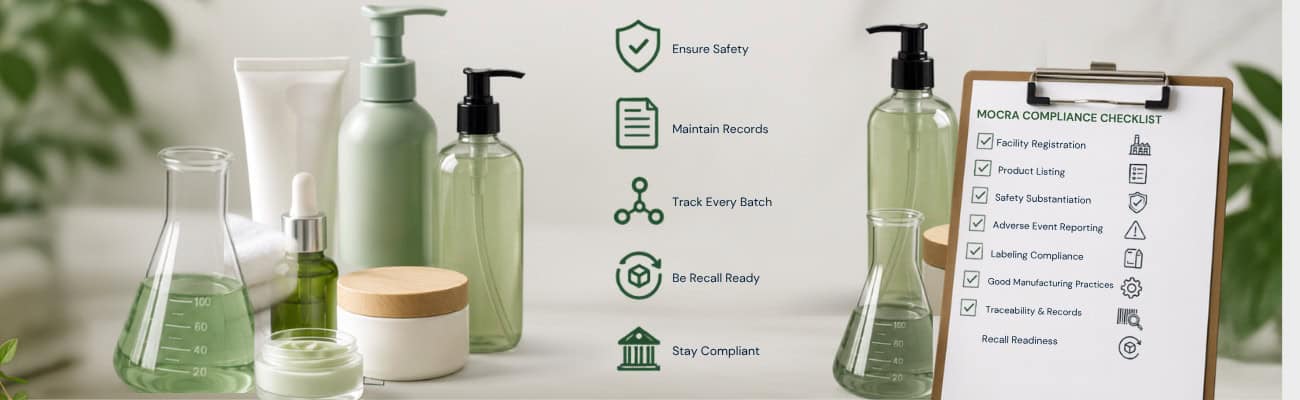
The MoCRA Compliance Checklist
Facility registration
- Register each manufacturing or processing facility with the FDA through the Cosmetics Direct portal.
- Obtain a facility identifier before submitting.
- Renew registration every two years. Facilities registered in 2024 face their first biennial renewal in 2026.
Product listing
- List every marketed cosmetic product with the FDA under the responsible person named on the label.
- Include a complete ingredient list for each product.
- List new products within 120 days of bringing them to market.
- Update a listing whenever the formulation, an ingredient, or the product category changes.
Serious adverse-event reporting
- Report serious adverse events to the FDA within 15 business days of receiving them.
- Retain adverse-event records for six years.
- Carry a U.S. domestic address or phone number on every product label so consumers can report events.
Safety substantiation
- Maintain records demonstrating the safety of each product, including supporting testing and data.
Recordkeeping
- Keep adverse-event, safety, and complaint records for the required retention periods.
- Be able to reconstruct, on demand, what was in a product, where it was made, and where it shipped.
Are You Exempt? Read This Before You Assume So
A limited small-business exemption applies to companies whose average annual U.S. cosmetics sales over the prior three years are under $1 million. It is narrower than it sounds:
- Confirm your three-year average U.S. cosmetics sales are actually under $1 million.
- Check your product types. The exemption does not cover products that contact the mucous membrane of the eye, are injected, are intended for internal use, or alter appearance for more than 24 hours.
- Remember that even exempt businesses must still meet adverse-event reporting, safety substantiation, and labeling requirements.
In practice, “exempt” rarely means exempt from the operational work.
Can Your Systems Actually Carry This?
Most of the checklist above is not paperwork you file once — it’s data that has to stay accurate as your business moves. Run this quick self-check:
- Can you trace any finished product back to the raw material lots and suppliers that went into it?
- Can you trace forward to the customers who received a specific lot?
- Is there one current source of truth for what’s in each product, so your FDA listings match reality?
- Are complaints and adverse events captured in the same place as your order and lot history?
- Will your records still be retrievable in six years, or are they scattered across tools you’ll have replaced by then?
If you answered “no” or “sort of” to several of these, the gap isn’t your compliance knowledge — it’s your systems. A single ERP solution that ties inventory, lot tracking, procurement, and customer records together produces this data as a byproduct of running the business, which is what turns MoCRA from a fire drill into a report you can already run. Kechie ERP is built for exactly the small and mid-sized manufacturers and distributors now facing these requirements for the first time.
What is on the MoCRA compliance checklist? The core obligations are facility registration with the FDA (renewed every two years), product listing with full ingredient lists, serious adverse-event reporting within 15 business days, safety substantiation records, a U.S. contact on labels, and multi-year recordkeeping.
When are the main MoCRA deadlines in 2026? Facilities that registered in 2024 must complete their first biennial renewal in 2026. New products launched in 2026 must be listed with the FDA within 120 days of market entry, and existing listings must be updated whenever product information changes.
How do I register a cosmetics facility with the FDA? Facility registration is filed through the FDA’s Cosmetics Direct portal, and you need a facility identifier before you can submit. Registration must then be renewed every two years.
What counts as a serious adverse event under MoCRA? A serious adverse event generally involves outcomes such as death, hospitalization, disability, disfigurement, or a serious health consequence tied to the use of a cosmetic product. These must be reported to the FDA within 15 business days, with records kept for six years.
Is my small cosmetics brand exempt from MoCRA? Possibly, if your average annual U.S. cosmetics sales over the prior three years are under $1 million — but the exemption excludes several product types (including eye-area, injected, internal-use, and long-wear appearance-altering products), and exempt businesses must still meet adverse-event reporting, safety substantiation, and labeling requirements.
Do I need special software for MoCRA compliance? Not compliance software specifically — you need operations that generate compliance-ready data. An ERP solution with lot and batch traceability, ingredient records, procurement history, and complaint capture produces the records MoCRA requires as part of normal daily operations.
Schedule a Free Demo Today!
See how Kechie ERP can transform your business, save you time, money, and aggravation. Click the button below to schedule your free demo.
Schedule Your Kechie Demo Now!