Apparel ERP Software: What Fashion Brands Actually Need to Run On
Apparel is one of the hardest categories to run on general-purpose business software, and most founders don’t discover that until they’ve already outgrown their spreadsheets. The reason is simple: a single style isn’t one product. A single tee in five colors and six sizes is thirty things to buy, make, count, sell, and reconcile — and that’s before you’ve added a second style or a second sales channel. Multiply that across a seasonal line and a few places you sell, and the math that broke your last system becomes obvious.
This guide is for apparel and fashion brands evaluating whether they’ve outgrown their current tools, and what to look for in an ERP solution that can actually carry the way apparel businesses work.
Why Apparel Breaks Ordinary Systems
Four things about apparel operations quietly overwhelm software that wasn’t built with them in mind.
SKU proliferation. Every style-color-size variation is its own stock position with its own count, cost, and reorder point. A modest catalog turns into thousands of individually tracked units. When your system treats each of those as an unrelated line item — instead of a variation rolling up to one style — ordering, counting, and reporting all get slower and more error-prone exactly as you grow.
Short, seasonal lifecycles. Apparel doesn’t sell forever. You plan a collection, produce ahead of a season, sell through a window, and mark down what’s left. Your system has to help you plan production and purchasing against demand you’re forecasting months out — and then help you move end-of-season inventory before it becomes dead stock. Reorder logic built for evergreen products doesn’t fit.
Selling everywhere at once. Most growing apparel brands sell wholesale to retailers, direct to consumers online, and sometimes through their own retail or pop-ups — all pulling from the same inventory. Without one real-time source of truth, you oversell, disappoint a wholesale account, and spend your week reconciling channel spreadsheets instead of growing the line.
Made, not just bought. If you produce your own garments, you’re managing bills of materials (fabric, trim, labor), cut tickets and work orders, contractor relationships, and landed costs from overseas production. That’s manufacturing, and it needs to live in the same system as your inventory and orders — not in a separate tool you rekey between.
What to Look For in an Apparel ERP
When you evaluate systems, hold each one against the realities above rather than a generic feature list.
Style-and-variation inventory tracking. The system should let you manage a style as a single item — a t-shirt — while tracking its variations (gender, color, size) underneath it, each variation with its own stock and cost.
That way you manage the whole style in one place instead of drowning in loose line items, but you still know exactly what you have of every color and size. This is the single most important capability for apparel, and the one most general systems handle poorly.
Multi-warehouse and multi-location control. Real-time stock across your warehouse, your 3PL, and any retail locations, with cycle counting so the numbers you’re selling against are the numbers you actually have.
Demand and production planning. The ability to forecast against a season and drive purchasing and production from that plan, so you’re producing to demand rather than guessing.
One inventory pool across every channel. Wholesale, e-commerce, and retail orders should all draw from and update the same live inventory, so a sale in one channel is instantly reflected in the others.
Integrated manufacturing, including work sent out. If you produce, you want bills of materials, work orders, and job costing in the same system as inventory and orders — so a finished-goods count and its true landed cost come from the same source. And because apparel brands rarely do everything in-house, the system should also handle outside manufacturing: sending goods to an outside vendor for embroidery, screen printing, label printing, or finishing, and tracking that subcontracted work rather than losing sight of it the moment it leaves your building.
Order management and returns built in. Apparel has high return rates and complex wholesale terms. RMA handling, order management, and customer history should be native, not bolted on.
Reporting you can actually use. Sell-through by style, margin by season, inventory aging, channel performance — the reports that drive apparel decisions should be available without a consultant or a custom build every time.
How Kechie ERP Fits Apparel and Fashion Brands
Kechie ERP is a cloud ERP solution built for small and mid-sized manufacturers and distributors, which is the profile of most growing apparel brands. It’s pre-configured out of the box, implemented in weeks, and priced on predictable per-user terms with no per-SKU surcharges — which matters in a category where SKU counts climb fast and consumption-based pricing can punish you for growing.
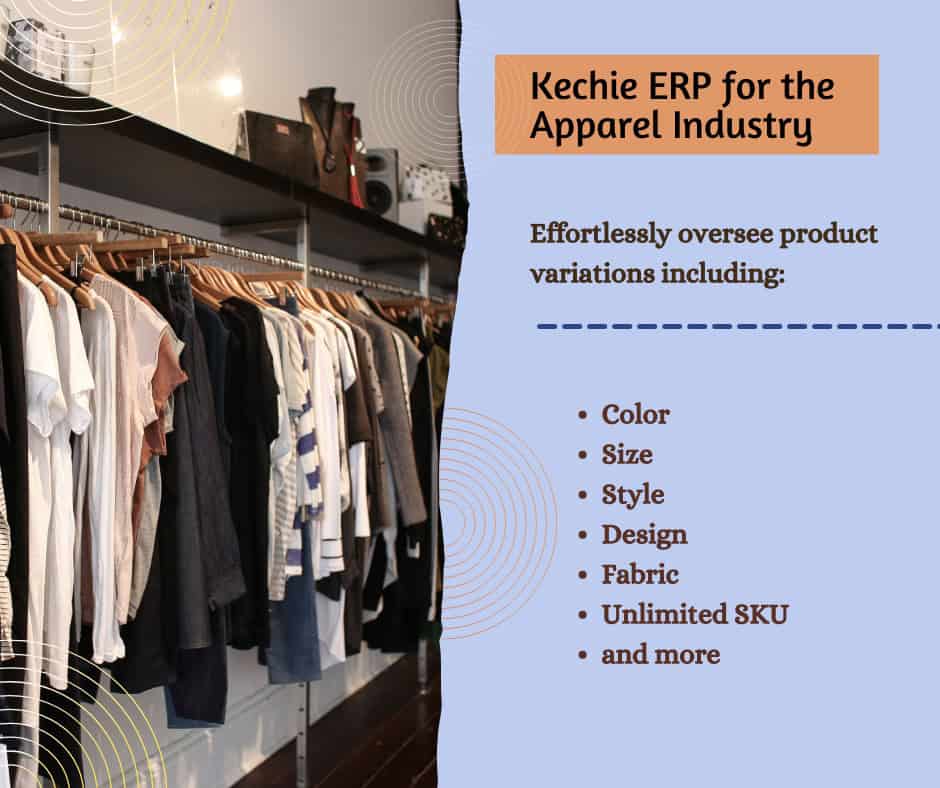
In Kechie, a style is a single item — a t-shirt — and its variations (gender, color, size) are tracked underneath it, so you manage the whole style in one place while still knowing exactly what you have of each color and size.
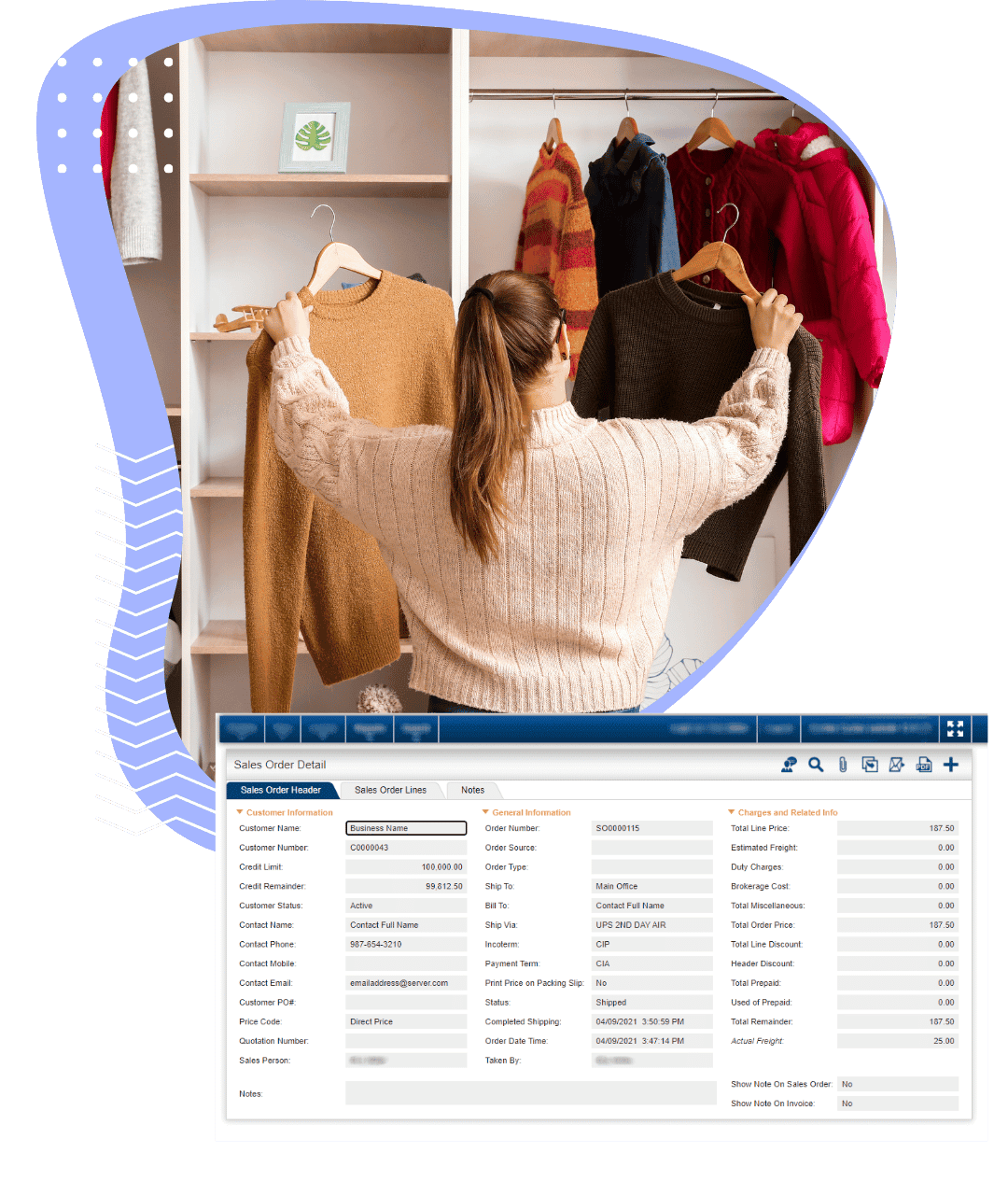
Its core inventory and warehouse modules carry that across multiple warehouses and locations, with cycle counting, lot and serial tracking, and a full audit trail on every transaction. Order management, procurement, logistics, RMA, and CRM are all part of that same core system, so wholesale and direct orders, returns, and customer history draw from one live inventory pool rather than disconnected channel tools.
For brands that produce their own garments, Kechie’s manufacturing module adds bills of materials, work orders, MRP, and job costing, keeping production and true landed cost in the same place as everything else. It also handles outside manufacturing — sending goods to an outside vendor for embroidery, screen printing, label printing, or finishing — so subcontracted steps are tracked in the same system rather than in a side spreadsheet. A B2B portal module is available for brands that take wholesale orders online, and demand forecasting is available for planning production against a season.
Because Kechie is highly configurable without developers, and because it ships with hundreds of reports built in, the sell-through, margin, and inventory-aging views apparel brands live by are available without a custom build. And because it’s one integrated system rather than a set of tools stitched together, the count you see, the cost you report, and the stock you sell against all come from the same source of truth — which is exactly what apparel operations need and rarely have.
Kechie was named to the Forbes’ Advisors Top 10 ERP list for 2025. For a growing fashion brand, the practical value is simpler than any ranking: one system that understands that a style is many SKUs, that a season has a beginning and an end, and that you sell in more than one place at once.
________________________________________
Frequently Asked Questions
What is apparel ERP software?
Apparel ERP software is an enterprise resource planning system built to handle the specific realities of fashion businesses: tracking inventory at the style-color-size level, planning seasonal production, managing wholesale and direct sales from one inventory pool, and — for brands that produce their own goods — running manufacturing with bills of materials and work orders.
Why do apparel brands need ERP instead of standard inventory software?
Because apparel multiplies complexity. Every style becomes dozens of individually tracked SKUs, sold across multiple channels, on a seasonal clock, often with in-house production. General inventory tools handle one or two of those realities; an apparel-capable ERP handles all of them in one system so your counts, costs, and orders stay in sync.
Can an ERP track inventory by size and color?
A capable ERP lets you manage a style as one item while tracking its variations — gender, color, size — underneath it, each with its own stock and cost. In Kechie, for example, the item is the t-shirt and male / red / large is a variation of it, so you manage the whole style in one place while still knowing exactly what you have of each variation. This is the core inventory requirement for apparel.
Does Kechie ERP support manufacturing for clothing brands?
Yes. Kechie’s manufacturing module provides bills of materials, work orders, MRP, and job costing, which cover cut-and-sew and assembled-garment production, and it runs in the same system as inventory, procurement, and order management. It also handles outside manufacturing, so work sent to a vendor for embroidery, printing, or finishing is tracked alongside your in-house production.
Can an ERP track work sent out to embroidery or printing vendors?
Yes. Kechie’s manufacturing module handles outside (subcontract) manufacturing, so when you send goods to an outside vendor for embroidery, screen printing, label printing, or finishing, that step is tracked in the same system as the rest of your production and inventory — rather than falling off into a spreadsheet while the goods are out.
How long does it take to implement an apparel ERP like Kechie?
Kechie is pre-configured and goes live in weeks, rather than the multi-month timelines common with larger enterprise ERP systems. Once the system is live, bringing an additional user up to speed on it typically takes only a day or two.
Schedule a Free Demo Today!
See how Kechie ERP can transform your business, save you time, money, and aggravation. Click the button below to schedule your free demo.
Schedule Your Kechie Demo Now!Related Articles
July 14, 2026
The ERP Growing Businesses Choose Over NetSuite
June 30, 2026
My Office Apps Adds Route Sales Capability to Kechie
June 17, 2026